



DB Press Technique Report
Posted on May 30, 2011 by xandolabs in Defense

“We want to deny clean vertical releases, that is our main objective. If a receiver is able to get vertical through our 'cylinder' or framework of our body the advantage of press technique has been negated,” says Doug Mallory, Co-Defensive Coordinator, Indiana.
By Mike Kuchar
Senior Research Manager
X&O Labs
mikek@xandolabs.com
We all want that lock-down corner, the Derelle Revis shut down stud who has the potential to alter an opponent’s game plan and change the course of the game. If the technique is played right, it can make an offensive one-dimensional or even cut the field in half. But let’s be honest – chances are a Derelle Revis or Champ Bailey may not be walking onto your practice field any time soon. So you have to make the most of what you have – and that’s what this week’s Coaching Research Report is all about.
For the purpose of this report we’ll be addressing techniques used by the isolated corner. We’ll assume he has no help, regardless of the coverage. We’re talking about MFO (middle of the field open), no middle field defender, just a corner on the receiver. It’s a coverage most coaches are scared to play, and perhaps rightfully so with the vertical elements the spread offense possesses. We were actually surprised to hear that 70 percent of coaches will only press their corners if they feel he has the ability to do so. So, we wanted to find out if it is your players’ lack of athletic ability or a reservation in your ability to teach the proper mechanics of press technique that prevents you from doing so. Apparently it’s both. Well, that’s why we’re in this business. We’ve consulted with the masses that use a press technique on a regular basis and they have given you an all-access look on how you can develop your corners into dominant defenders. Sure, that Revis-type may not be coming in the building any time soon, but after reading this report, you may not need him to.
Benefits of playing press man coverage:
- Ability to stack the box with nine: Assuming you’ll get closed, tight end oriented sets, if your corners can play man coverage without the help of your safeties, it frees them to get down in the box and play run support.
- Safeties can’t get cracked: Many defenses now are playing some form of quarters coverage to contend with the vertical pass game (Note: X&O Labs will be finalizing a Coaching Research Report on quarters within the next couple of weeks). Because offenses know that in quarters your safeties are tied into the run game, they will try to block them with receivers. Playing tight press man takes away their ability to do so.
- Develops your blitz package: You’d be hard pressed to show us a defensive coordinator who lacks aggression in the blitz game these days. If you can teach man coverage, it gives you the ability to attack various man and zone pressure concepts.
- Eliminate big plays: We’re sure some of you offensive guys are cringing at a bold statement like this. We know that seeing some form of press man coverage outside can make you drool. But the truth is if you train the hands, feet and hips of your corner to handle all routes, particularly the dreaded fade and fade stop routes which we will discuss later, you limit the offenses’ chances of hitting that home run.
Case 1: Proper Stance/Vertical and Horizontal Alignment
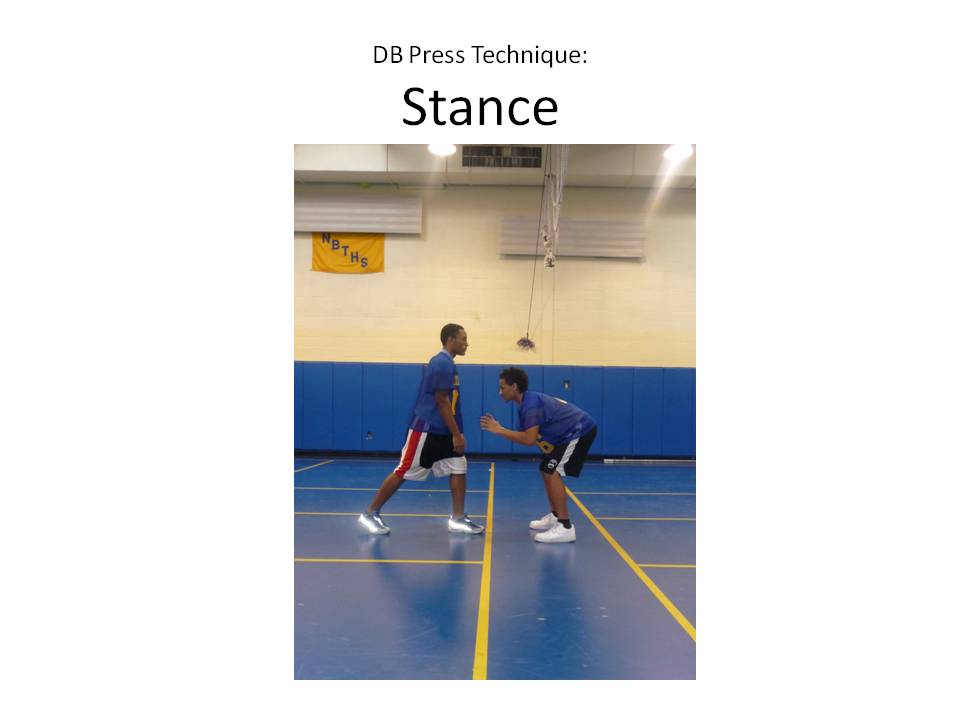
The responses were unanimous. Nearly every coach we spoke with on this topic talked about how the feet will control the hands. There is nothing more important in teaching press than teaching the play of the feet. We couldn’t tell you how many times the mantra “feet first, then hands” was blurted over my cell phone line this past week. But before you can play the feet accurately, you must be able to get into a good stance. Many coaches, including the ones we have as our analysts, feel that teaching the stance of a press corner sometimes goes overlooked. At the risk of boring some veteran coaches, we put together a majority consensus on what a stance should look like for a press corner:
Press Corner Stance (Picture 1)
- Feet directly under armpits: Slightly tighter than shoulder width. This provides for better explosion off receiver movement and the prevention of getting over-extended and lunging on a WR, which many of our coaches feel was the biggest problem area when teaching press.
- Bend at the waist: Much like a sprinter, the stress should be on their hamstrings, which need to be one of the stronger ligaments in a corner’s body.
- Hands at the ready: Since the play of the hands are vital to success in press, the corner’s hands should be in the “up” position with elbows in and thumbs up. This provides for an aggressive strike point on receivers. We should mention that some coaches of the press technique, like Greg Brown, a well-reputed leader in the field, teaches his corners to hang their arms with fingers spread. This provides for a relaxed posture.
- Eyes Fixed: We found that this may vary as well. Some coaches teach the focal point to be the bottom of the receiver’s numbers while some teach the belt buckle or waist. Whatever the focal point, one common denominator was clear in our research. Do not look at the QB in press technique. Your eyes should solely be locked on the receiver you are covering. We’ve found it interesting that some coaches won’t even press their corners if they have to read number two, like in some two high schemes. The eyes are that important.
Press Corner Leverage
When we refer to leverage, we’re speaking specifically about the horizontal and vertical cushion a corner should give to a receiver. Our studies show that the majority of coaches, 34 percent, teach their corners to line up less than a yard off the line of scrimmage. I remember hearing Mark Stoops speak at a clinic years ago when he was a defensive backs coach at Kansas State and him saying that deciding how much ground you’re going to give a receiver is strictly dependent on how good he is. Coming from Stoops, this made a ton of sense, but I quickly found that I was not that good of a coach to assess my player’s abilities individually, so I had to give them a reference point.

We know that almost every fundamental or technique in football is in direct proportion to the ability or skill set of your players but one of the best reference points we’ve learned is the ones that Greg Brown, a veteran NFL mentor who has the best video out on bump and run play (no matter how old it is) used to give his players. He breaks it down to two distinct leverage points:
- Ork Technique: The corner maintains outside leverage on a receiver, by splitting the crotch of the receiver with the inside foot (Picture 2, ball is to the right). This is used when the corner has middle field help (MFC) on a receiver by having a post safety.

- Ink Technique: The corner maintains inside leverage on a receiver by splitting the crotch of the receiver with the outside foot (Picture 3, ball is to the right). This is used when the corner has no middle of the field help (MFO) on a receiver. It’s mainly used in two high or no high defensive structures.

Note: Generally, split rules do override the assigned shade. Example: if the corner is using an Ink technique and the WR is tighter than normal, a corner may adjust to an Ork technique. Some coaches tell their corners to be in an “arms length” alignment, meaning if the receiver is on the line of scrimmage the corner should be able to touch him with his fingertips. If the receiver is off the line of scrimmage, the corner should be two yards away from him.
Get Instant Access to X&O Labs’ Full Library of Game & Practice Video – Plus Full Length Reports and Interviews. Click Here!
Case 2: Play of the Feet
Since the play of the feet comes first, we will start there. In fact 79 percent of the coaches polled believe that the feet are more important than the hands in press technique. To me, this is an invaluable coaching point considering the first thing 15-21 year olds want to do is bench press their respective receivers when they line up in a press alignment. As coaches, we need to work hard to enforce the idea that the feet must move before the hands. Without question, one of the most used drills in press technique has been the Mirror Drill. Here a receiver and defensive back will line up facing each other within a five yard area. The receiver will work side-to-side inside the five yard area while the defensive back must “mirror” the footwork of the receiver moving his feet before his hands and not engaging across the line of scrimmage. Engaging the line of scrimmage early is a problem area we will discuss in more detail later on in this report.
So, generally speaking, there are several ways to play the feet in a press technique. Based on our research, we found coaches use the following techniques when teaching how to move corners’ feet: Just for clarification purposes, we listed them based on majority.
- Buzz/bounce technique: This resembles more of a foot fire, where corners will pick their feet up and down in a quick manner anticipating the release of the receiver. The majority, 31.6 percent of our coaches favor this technique.
- Shuffle technique: This is more of a lateral movement, again mirroring the steps of the receiver. 31.1 percent of our coaches favor this technique.
- Slide or step back technique: Here the corner will slide back or step back with his inside foot in order to keep inside leverage on a receiver. Essentially, it buys him time to react to what the receiver is doing – 18 percent of our coaches favor this technique.
- Hop Back: Here the corner will hop back about six inches with both feet in order to buy him time to recognize the route of the receiver – 8.3 percent of our coaches favor this technique.
If you’re seeing a common thread here you’re right. It’s all about PATIENCE, yes patience. We’ve found that word association alone in press technique tells corners to be aggressive and jam receivers at the line of scrimmage. But the bottom line is, the press technique is more of a thinking man’s game than anything else. Let the receiver declare first, then attack.
All of these above techniques could be effective, but it’s our job as coaches to identify which techniques can be utilized by our players. One of the ways Mike McMahon, the defensive coordinator at the University of Mary in Bismarck (ND), does this is by sitting his players down in a classroom and showing them the video of all these techniques. Once the players watch the video, they stand up in the classroom and display each of the techniques. While it may be a glorified version of show and tell, it gets the job done. McMahon is able to identify which players can use them effectively.
“After we show them all of the techniques, we ask them to develop one that they are comfortable with,” says McMahon. “I’ll abide by whatever they do naturally the best, as long as their feet are moving backward and they stay balanced. I don’t want to over-coach them. As long as they get their feet moving backwards I don’t care which ones they use. It usually takes about three days to learn the technique. The majority of them are hoppers or shufflers but they need to master their craft. Eventually the receiver figures it out that the corner is not really pressing him, he’s moving back on the snap. So now we change up our techniques against a particular wide receiver.”
One of the more popular techniques we’ve found that coaches use is the Angle kick technique (Picture 4). Once the receiver declares his stem (outside or inside), the corner responds by opening up his hips on a 45-degree angle. It’s the primary technique that Doug Mallory, the co-defensive coordinator at Indiana University uses to teach his kids. “We want to deny clean vertical releases, that is our main objective. If a receiver is able to get vertical through our “cylinder” or framework of our body the advantage of press technique has been negated,” says Mallory. “As soon as the receiver is flattened down and gets to the point where he’s outside the “cylinder” of the DB’s body, the defender is now instructed to open his hips and lead step in the direction of the release. We refer to this as an “angle kick” technique. What we’re trying to do is gain depth down the field at approximately a 45-degree angle to enable us to stay on top of the receiver. If a DB doesn’t “angle kick” and instead crosses over, he’ll lose one to two steps in coverage and be in a low alignment to the receiver.”

Two general points we found to be conclusive that we want to make regarding post-snap reads on a receiver:
- If the receiver dances, dance with him – don’t attack him. Steve Specht, the head coach at St. Xavier high school (OH) calls this the “cat and mouse” game. Be the cat and not the mouse. Make him come to you. The longer he takes to get off the line of scrimmage, the more time you’re allowing the rush to get to him. The QB will learn quickly.
- Most breakdowns in coverage occur within five yards of the line of scrimmage, so you need to spend the majority of your time as a coach in this area. Recognizing routes are secondary compared to technique.
Since we are a research based firm, we’ll start with your concerns on the proper use of the hands in a press technique. Of all the problem areas when teaching press coverage, losing proper hand placement was the biggest concern at 40.5 percent. So, while the feet are primary when teaching the technique, the hands must work in conjunction. One of the more common debates we arbitrated was whether or not to use a one-hand stab or a two-hand jam when teaching press. Well, the results are in. 62.5 percent of coaches teach the one-hand stab to their press corners as opposed to the two-hand jam.
In fact most coaches, like Mallory, only use the two-hand jam if the receiver attacks the corner’s cylinder immediately (Picture 5). In essence, it’s done more as a default than anything else. Adversely, the “off hand jam” is the hand technique of choice among coaches today. Off hand simply means opposite hand. For example if the receiver releases to the corners right, he uses his left hand to lock out and jam at the shoulder or hip area. Conversely, if the receiver releases to the corners left, he uses his right hand to lock out the receiver while opening his hips.

“The hands work in conjunction with “angle kick,” says Mallory. (In Picture 4 the receiver has released to the corners left, so he locks out with right arm). Once the receiver begins to get vertical into his release, as we angle kick, we want to incorporate an off hand jam to the receivers near shoulder tip. When we off hand jam, we want to have our thumb up, elbow locked and press the receivers shoulder to help continue to flatten out the release and enable the defender to stay on top of the receiver. A common mistake that players will make is to try to jam with the near hand. In this case, they’ve created a problem by locking their hips and not being able to get down field and stay in phase with the route. (In picture 6, the corner has incorrectly used his near hand, therefore locking his hips.)

Case 3: In-Phase Techniques
For definition purposes, “in-phase position” simply means that the corner is in an advantageous position to the receiver. Many coaches feel that being inside and on top of a receiver (remember we’re referring purely to no-help man in this piece) is considered in-phase (Picture 7, the corner is #46 to the right of screen). Some coaches feel that regardless of up-field leverage, if the corner can reach out and touch the hip of the receiver he is in phase. When your corner is in-phase, his success of defending various routes increases.

Now the focal point of a corner in-phase shifts from the number, like it was directly post-snap to the head or eyes. The key is to match the receiver’s angle. The receiver’s position will determine which way you will turn to the ball. One of the more prominent routes against press coverage has been the back shoulder throw or fade route. Offenses will take their shots with this route if they see you in press, so you need to know how to defend it. According to Mallory, the best way to defend it is using a “lean and locate” technique (Picture 8). Once the receiver declares the outside release, the corner must lean into his body and keep leverage to the sideline.

Note: Many teams call this the lawn of the field, an area four yards from the sideline forcing the QB to make a difficult throw. If he the receiver is pinned to the sideline, turn your head inside so you can lean and locate the ball.
“If the receiver begins to chop down on the outside release, we want to match his stride and react back on the comeback route. If the receiver is long striding through 15 yards, we want to bring our vision back up to the receiver’s eyes and begin to apply pressure back into him and turn and locate the ball,” says Mallory. “Now, if the receiver releases inside, we will play outside and up field leverage. Most likely the route will be broken off to the inside, (save for the corner or “9” route). We tell them to continue to flatten out the release and try to keep him from getting vertical into the route.”
Case 4: Out of Phase Techniques
Of course, if you’re not in-phase with a receiver, than you must be out of phase. Out of phase means you have lost the up field shoulder or lead position (in picture 9 the corner #46 has lost up field positioning).

When found in this precarious position, there is one thing all of our coaches agree with: PLAY THE MAN AND NEVER LOOK BACK FOR THE BALL (at least until you get close enough to touch the man). Now the focus needs to be completely with gaining ground on the receiver and hindering his route. According to our research there are several ways you can do this:
- Wedge (Picture 10): This is the most common technique used when in the trail, or out-of-phase position. Here, the corner “wedges” his left forearm into the hip of the receiver prying himself into position. Can also be used on the deep routes.

- Wrist Grab (Picture 11): In order to break the receivers stride and slow him down, a corner may execute a wrist grab by grabbing the wrist of the receiver (quickly) with his inside hand.

- Thigh Slap (Picture 12): Similar to the wrist grab, the corner slaps the nearest thigh of the receiver again to break his stride or slow down his momentum.

- Pass Interfere: Now, we’re not telling any one to cheat or break rules, but our question is if the game is on the line, will you give up 15 yards or a touchdown? You make the call.
Researchers’ Note: You are reading the summary version of this Research Report. To access the full version of this report – including the corresponding Statistical Analysis Report featuring the raw coaching data from our research – please CLICK HERE.
Concluding Report
I just wanted to take a minute to formally thank everyone who has been reading and responding to these reports. It’s been as tremendous a learning experience writing them as it is for you to read them. Our support has continued to grow and we encourage any research ideas you may have. Again, just like you, we love talking ball. Hope to hear from you soon.
Copyright 2011, X&O Labs, LLC


NCAA rules:
“Deliberately teaching players to violate the rules is indefensible.”
I find each one of your techniques for the out of phase defender to be extremely questionable ethically. I believe teaching them to be a clear violation of the ethical clause in the rules.
Basically, you are saying “if you need to cheat to win, it’s your call”. Remember, it’s not just coaches reading these articles, it’s players too. Do you want to be the guy whose teaching players around the world to use unscrupulous tactics?
But, it is always good to know what the cheaters are going to try to make sure my players are prepared against it.
Come on! You are joking right?!
I would like to add that I found the rest of the article to be highly informative, thorough and in general “excellent”.
Thanks for reading, Ted. While reporting this piece, I was basically echoing the sentiments of some highly respected defensive back coaches in the game who thoroughly teach their players the rules of the game. We certainly are not condoning cheating, just giving the best practices (based on research)to defend talented receivers. Because of the discrepancy of rules between high school and the pro’s, I can see how some of these practices can hover along that line.
Ted – get over yourself…
A lot of football is the gray are of the rules. That is why the refs are there to decide when the rule has been broken “too much.”
Here is a stool to get off your high horse…
Great article – I just forwarded it to my DB coach…
How exactly do you teach a db to cover a faster receiver that is trying to take him deep?
this question is for Coach Ted. Sorry
The articles at X&O are fantastic with this article being a standout among them. It is obvious that no stone was left unturned and it is well-researched reporting at its best.
The problem arises from the NCAA ethics clause which acts as a handcuff on coaches. This article is a definitive source and coaches obviously want to help their players be their best and to have the tools to deal with any situation by passing this information on to them.
It is quite a dilemma. You know that some of the techniques are “gray” area which means you know that they are technically against the rules (but seldom flagged). At that point you are bound by the NCAA ethical clause to not teach.
I believe that the first role of a coach is teaching boys to grow to be respectable, young men. If I can’t expect myself to follow the rules and play with good sportsmanship how can I expect that of my players. I don’t consider this to be a high horse, just my duty as a coach.
@Terry. This question would probably make for a great article here at X&O labs and I hope to see it soon! I am certainly no expert, but when my teams have faced a stud receiver in the past we did what everyone does – double him up. This could mean either a safety over the top or bringing an extra player underneath and letting the corner play high. We also played with putting out #1 corner on the #2 receiver on an island so we could double with #2. I think it is the role of the coaching staff to develop a scheme that protects your corner based on different looks, matchups, rotations and of course giving expert technical advise like found in this article.
Great article. I coach defensive backs at the high school level. Some of these skills are great. I especially love the tips for being out of phase.