


Zone Pressure Concepts Against Spread Teams
Posted on May 29, 2011 by xandolabs in Defense
By Mike Kuchar
Senior Research Manager
X&O Labs
mikek@xandolabs.com

Mark Dantonio, head coach at Michigan State: “If the ball is thrown deep to the outside receiver, he (DB) wheels his head around, locates he ball, and goes for the ball. If the ball is thrown to the inside receiver, he plays the ball since he’s facing that way.”
Case 1 – The Prevalence of Boundary Side Pressures
After extensive research on the topic of zone pressures, X&O Labs (www.XandOLabs.com) has discovered that the majority of football programs blitz more to the boundary than to the field or to open or closed offensive sets. Over 31 percent of coaches polled at all levels of football have professed that their most successful zone pressure package is one that attacks the boundary side of the field. In fact 71 percent of coaches polled that elected to blitz more from the boundary had a winning percentage of 70-79 percent. This is no coincidence.
According to our studies, a zone pressure from the boundary is disguised more easily and is difficult for opposing QB’s to detect. Fifty-two percent of our coaches employ a three-under, three-deep zone principle in their pressure packages. When a coach employs a zone pressure with one deep safety, many teams will show a two-deep shell pre-snap to show disguise. Either pre or post-snap, one of those safeties will rotate into the flat area. When a safety rotates to the field side, it is easier to identify by the offensive line and the QB. The boundary side presents a completely different issue.
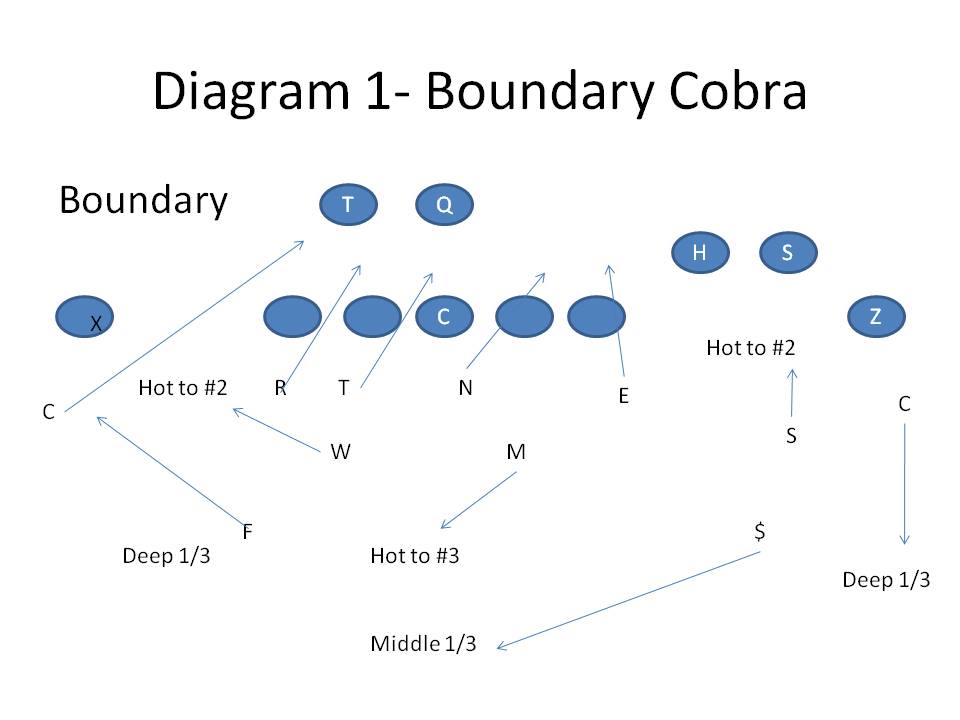
On most occurrences, the boundary side corner is the active blitzer in these schemes. Based on responses, the most common scheme was the Boundary Cobra (Diagram 1). Here, the blitz is instituted out of a four-down, field under front, where 3-technique tackle is set to the boundary. The corner comes hard off the edge as the force blitzer while the Rush end and 3-technique slant away from the blitz. Out of a traditional three under, three deep coverage rotations, the weak side LB will play hot to #2, the Mike LB is hot to #3, while the free rotates to play the final #1 to the blitzing corner side.
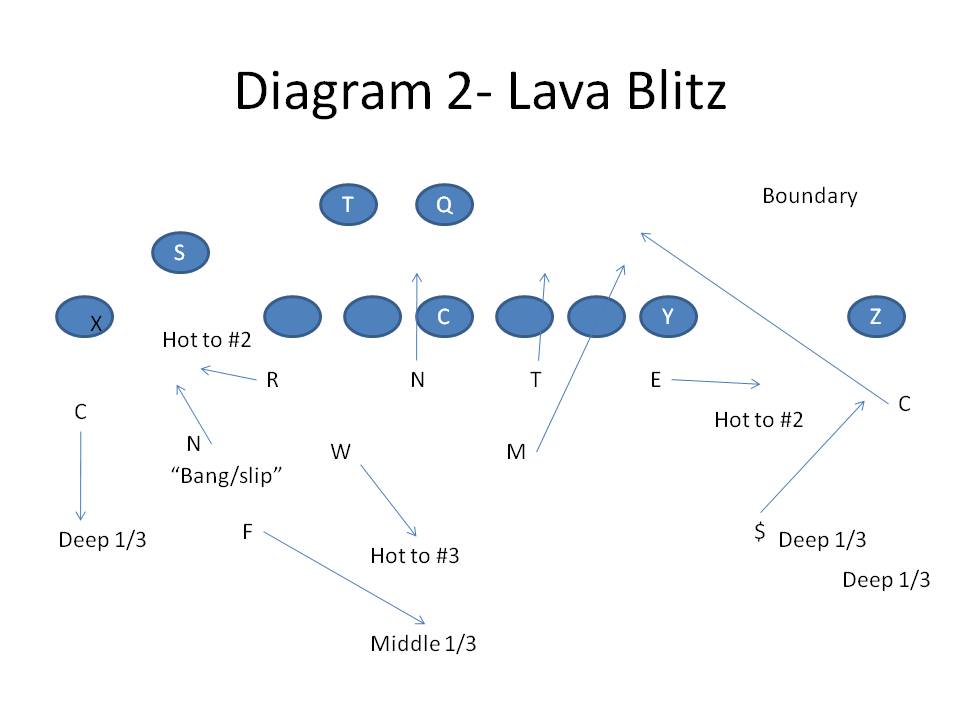
The second most common boundary pressure according to our research was simply called “Lava” by our analysts (Diagram 2). Lava is another corner blitz, but mainly used when offensive teams will displace their tight end to the boundary. Now the offense has presented a three-man surface, so an extra gap needs to be accounted for. Sixty-two percent of the programs surveyed, ran the “Lava” package out of a 4-2-5 defensive structure. The corner still comes off the corner and is responsible for any pitch on option. The weak side defensive end must run to get under #1 receiver on the snap while the strong side LB (M) runs into the C gap. The weak side LB (W) rushes the weak B gap. The Nickel (N) executes what coaches referred to as a “bang and slip” technique to collision any number two receiver to the field side. The strong safety (S) must get to deep third immediately to cover the final number one receiver. The blitz side defensive end will play the hot to #2.
While the Cobra blitz package was a productive pressure for our coaches, its limitations lie in sending three weak to the boundary side. In order to get a four man pressure to the boundary side, our coaches dialed up pressures out of the four-down front to send the weak side LB and the Mike LB (Diagram 3). The weak side defensive end is off the edge, while the Will crosses into the A gap and the Mike scrapes into the B gap. Will is the penetrator and the Mike is the looper, with the Will going first. The corner plays deep third while the free safety rotates to play hot to #2. The strong side LB (Sam) will play hot to #3 or the middle hole defender. Again, this pressure is ideal to a two-man surface where team will often have just two gaps presented (A and B gap). The nose executes a RAC (rip across center’s) face to clear room for the Will.

But what gave our coaches the most efficient way to send four weak to the boundary is to run it out of a three-down front where you can get an extra defensive back or linebacker on the field. Simply referred to as “Bama” by our coaches, this blitz is run out of a 3-4 alignment (Diagram 4). The boundary end executes a long stick by spiking into the A gap, while the Nickel is the contain rusher to the blitz side. The Mike runs a blitz off the C gap making sure to peel over the top of the running back’s block for containment. The strong safety goes to the middle of the field to cover the middle third. The free safety moves out to take the Nickel’s coverage on the number two receiver. The Sam plays hot on the number two receiver to the other side and the Will LB plays hot to #3.

Case Two – Problem areas: Handling the 4-Vertical Passing Game and Quick Game
According to our research, the most common problem area for defensive coaches when dialing up zone pressures is the quick passing game and perhaps even more troublesome, the four vertical passing game. Our responses for remedying the quick, three step game came in three fold. The first solution was to continually drill the technique of the corner on his three step progression. Over 65 percent of our coaches teach the corner to “clear three step read” before going into their back pedal. Many of them will key the EMLOS or the offensive tackle for a high hat (pass) or a low hat (run) read while buzzing their feet. This would give them enough time to drive on any quick routes while buying the hot to #2 player to get underneath all quick routes by that number one receiver.
Get Instant Access to X&O Labs’ Full Library of Game & Practice Video – Plus Full Length Reports and Interviews. Click Here!
The second solution is to play what our coaches called a “soft” squat technique by the corners. It was Mark Snyder, the former head coach at Marshall University, and now the defensive coordinator at South Florida, who said: “We call it 2-Z. It is simply a cover-two coverage (Diagram 5). The number two tells us that the corner to the field is no longer playing one-thirds coverage. He is going to roll up and play a soft squat technique to the field side (which works well with the boundary fire). He is looking to make the interception on the quick hitch route. We have played these with both an inside and outside technique.” The corner rolls from seven yards to five yards and again, executes a flat foot read with his eyes completely on the receiver, not on the EMLOS. This is something one of our analysts, coach Jeff Schaum at Victory Christian in Florida, runs as well. “Sometimes we’ll even have the corners press with inside leverage to force the QB to throw the long ball,” says Schaum. “We’ll use the sideline as leverage; it’s a much longer throw for the QB.”

As far as handling the four vertical pass game, most commonly seen in spread offenses, thirty-six percent of coaches teach the hot #2 player, or seam player to run with any vertical route. Many of our coaches refer to this player as the SCIFF player, which is an acronym for Seam, Curl, Flat (routes) in order of defending priority. Our feedback showed that many coaches had a discrepancy between whether they should leverage the four vertical game with the deep safety or with the SCIFF player. As it turns out, 36 percent of our coaches felt that the best way to handle the inside vertical is to leverage the SCIFF player who is away from the side of the pressure. The player who is rotating to the side of the pressure needs to drive on the flat right away because the QB is getting heat in his face immediately. Traditionally, the deep safety now will have clear vision to the play side number two receiver as he releases vertical. According to our coaches, it’s the back side SCIFF player that needs to handle any back side vertical route. However, the problem lies in when you have a rush or open side end as the SCIFF player, now you’re asking a lot for a defensive end to carry a vertical route. In order to combat this issue, some coaches we’ve spoken with ask their corners to play a “divide” technique on both verticals to his side. This is a traditional teaching technique to most cover three schemes. As the cornerback executes his bail technique, his eyes are on the QB. If the QB peeks at the inside vertical, he cheats 2/3 to that inside vertical, it’s an easy adjustment because he’s already facing that way. “If the number two receiver breaks up the seam, the corner forgets about his relationship to the number one receiver, gets on his divider and carries his depth according to the depths of the receivers,” says Mark Dantonio, the head coach at Michigan State. “If the ball is thrown deep to the outside receiver, he wheels his head round, locates he ball, and goes for the ball. If the ball is thrown to the inside receiver, he plays the ball since he’s facing that way.”
Researchers’ Note: You are reading the summary version of this Research Report. To access the full version of this report – including the corresponding Statistical Analysis Report featuring the raw coaching data from our research – please CLICK HERE.
Concluding Report
For the last several years, spread offenses have been the catalyst of change for many different defensive structures and philosophies. Defenses cannot sit back and let opposing QB’s make their reads and deliver the ball in a timely fashion. Zone pressure packages were designed in order to disrupt the timing and rhythm of offenses while keeping everything in front of them with the advantage of having a deep safety. While the variety of zone pressures are endless, we’ve found that making adjustments to what the offenses is presenting is often the best practice when implementing these zone pressures.
Copyright 2011 – X&O Labs


Good insightful information it can help young coaches to continue growing in terminolgy ,and concepts of the different schemes.
This was a great introductory article. I am a young coach about to install my field and boundary zone blitzes. I’d like to see more reports on specifics of zone blitzes though, that’d be great!
In 2-Z coverage is that “Squat” CB also the 1/2 field player on his side or is he playing #1 man to man?
Brian,
He’s manned up on that receiver because the half field rotation is away from him. Similar to a robber technique, he must protect the post area. He has to handle all vertical routes, but has help from the end on any out breaking routes. Hope this helps.
Mike
Coach, in regards to Mike Dantonio’s coaching the CB to cheat in on the #2 receiver going vertical…who would get #1 if he sells deep and runs a 10-15 yard stop pattern?
Dan,
Assuming you’re referring to the squat corner- he will take the first to the flat while the deep safety will cheat to play any vertical routes by #1. If both the #2 and #1 receiver go vertical, that front side corner must continue to get depth on #1. Hope this helps. Let me know if you need more clarification.
what does the terminology ‘Hot to #’ mean?
Hot, refers to the coverage responsibility in a fire zone or five man pressure blitz. Defensively were expecting the ball to come out right now because of the pressure or “HOT”. Hot also refers to the adjustment call that many offenses use called hot routes to defeat the blitz. A corner playing a HOT 3rd will expect the ball to come out right now, if not he must get deep right away, because the offense has protected against the pressure and are taking a shot on the deep ball.