



The Hitch Concept
Posted on December 12, 2011 by xandolabs in Offense
Using the Quick Game to Win First Down
By Dan Ellis
Head Coach
W.C. East High School
Throwing the football is something we did this past season with enormous success. We threw it often and threw it well. However, it is not necessarily the number of attempts you try in a game, but it’s the efficiency with which your QB executes the passing game that matters. When you choose to call passing plays, completing the ball is of the utmost importance. The first play we install in the passing game is our Hitch Concept. The reason behind that is simple – if teams allow us to throw the hitch, we will take advantage of it all day. We tell our QB’s it’s a steal if they allow us to throw it consistently.
The Hitch Concept carries both a horizontal and vertical stretch. It has multiple coverage beaters imbedded. In this report, I will explain the concept, QB footwork and progressions and the different ways we have to run the play.
Hitch Concept:
With the Hitch Concept, our goal is to get the ball out of the QBs hand as quickly as possible and to win first down. Like any offensive coordinator, we want to get into 2nd down and short and keep the playbook wide open. Short passing game on first down is a great way to do it, especially if defenses are playing the run with a middle closed coverage (Cover 1 or 3). Here is the basic concept(diagram 1):
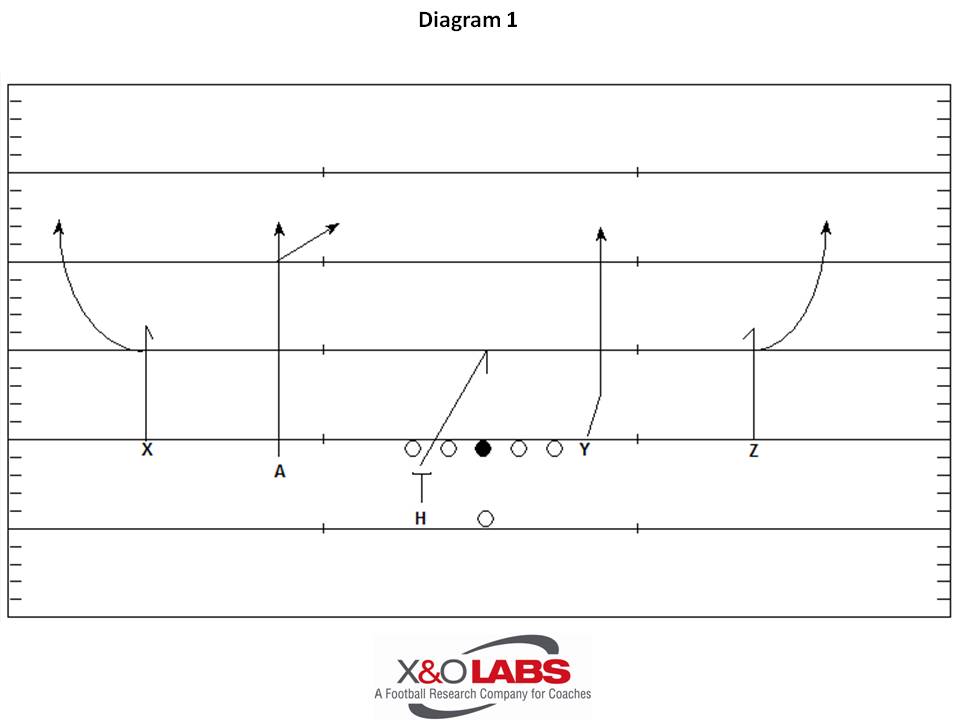
Rules:
- QB – Middle of Field Open (MOFO) – 5-step. Middle of Field Closed (MOFC) – 3-step.
- X – 5 step hitch (will convert against press/hard corner)
- Z – 5 step hitch (will convert against press/hard corner)
- A – Post to Get Open or Bender. If the MOFO (cover 0, 2, or 4), the A will run to the open space. If MOFC, the A will run a seam.
- H – Ball route
- Y – Seam
MOFC – Middle of Field Closed (Cover 1, 3) – Horizontal Stretch:
Against MOFC coverages, we are looking at a scheme that will horizontally stretch the defense (diagram 2).
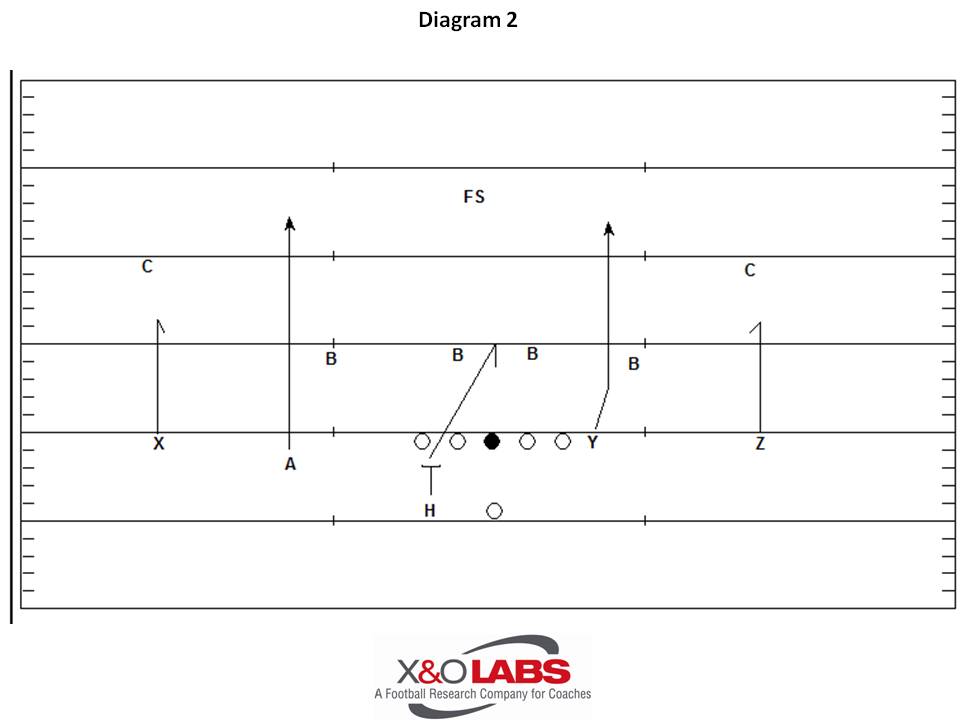
With the middle of the field closed, the X and Z will be most likely running hitches and the A and Y will be running seems as shown in diagram 2 against cover 3. We teach the QB to take the most advantageous side because we have mirrored routes. In this case against cover 3 with the MOFC, we know that we can get the hitch. So whichever side the QB feels easiest to get the hitch, to work that side of the field (based on alignment OLB, depth of CB, etc.).

When the QB is under center, he will take a 3 step drop and his progression is as follows:
- Hitch
- Seam
- Ball (back out of the backfield)
Again, we want the QB to throw the hitch unless it is taken away from us. On his first step from under center, we want the QB to keep his eyes down field and then to locate the WR on his second step, with the ball coming out on his third step.
If the OLB jumps the hitch immediately, the QB will locate the seam player and make that throw on the seam behind the OLB. This is NOT a deep throw. We teach the A/Y, with the MOFC, to look immediately after they pass the OLB for just this reason. If the ball is in the air too long down the seam, it gives the S and CB an opportunity to make a play on it.
If the OLB jumps the hitch, and the ILB gets under the seam route, the QB would then dump the ball to the H on his ball route as the outlet.
If down and distance dictates (ex. 2nd and short), we do allow the QB to make a seam read while taking a 5-step drop. In this situation, if we have a favorable down and distance on the field, we may take a chance to get a big play. The QB will use his eyes to control the S and attempt to hit one of the seams (A/Y). He should be controlling the safety with his eyes, by looking one way and throw the other. Again, this throw is a “stick ‘em” kind of throw, right off the 5th step. The QB needs to beat the ILB and the CB on the throw and the H would always be the dump if either seem was covered.
Hitch Concept Film: Dan Ellis’ W.C. East High School
Get Instant Access to X&O Labs’ Full Library of Game & Practice Video. Click Here!
MOFO – Middle of Field Open (Cover 0, 2, 4) – Vertical Stretch:
Against MOFO coverages, the hitch concept now will turn into a vertical scheme where we are going to try to attack the middle of the field (diagram 3).
If the QB comes to the line and sees MOFO, he knows that he will have the A bending on his Post to Get Open and probably two conversions on the outside by the X and Z if it is cover 2. The QB will be taking a 5-step drop as well. His progression is:
- A –Post to Get Open
- X – Conversion
- H – Ball route
The QB needs to be hitting the A from 16-22 yards, and no deeper. If the QB is making the throw deeper than that, he will bring the safety into the play. This throw is a 5-step and “stick ‘em” throw, too. If the QB cannot make the throw because the ILB is dropping underneath (like Tampa 2), then we tell him to immediately find the H in the vacated area. If the safety takes away the throw to the A, then the QB will look immediately to the X on his conversion.
Key coaching points – some players will want to run their Post to Get Open at the depth of a LB. They really need to push to 10 yards. Sometimes the A will come up short, but we really stress to get to 10.
3 x 1 Variations:
If we run this play out of a 3 x 1 look (diagram 4), the Y will be working to the opposite hash to have the proper spacing on the field. We tell him to work to 18 yards on the hash.
Variations:
There are several different formations, both 2×2 and 3×1. Here are a few (diagram 5 & 6):
This last variation that we’ve used is something we use out of our bunch look (diagram 7). The only true difference is that we tell the Z, in bunch, to run a flat route. It’s a little different of a look, but the basic concept is same.
Conclusion:
The hitch concept is one of the easiest concepts that we use. Our goal is to win on first down and to take what the defense gives us. This concept allows us to stretch the field both horizontally and vertically depending on the coverage we see. It’s a high percentage, 1st down throw and can get us into the down and distance situations where we can use our entire playbook.
Question or Comments? Dan Ellis has agreed to be available to answer your questions about his Hitch Concept. Post your question or comment in the “Comment” section below and Coach Ellis will respond shortly.
Copyright 2011 X&O Labs


In diagram 3 vs. MOFO, do you ever run Y on the bender route & A on the seam? If so, how do you(or the QB) call the switch between Y & A?
Coach, you can easily designate who you want to be the bender. We have done the Y in the past, but in our offense right now, the A is our more dynamic player.
Sometimes we have changed the bender by game plan. Other times we’ve simply tagged it. That is a good and simple adjustment to make.
Very good concepts and it is obvious the
kids were coached well. Thanks for
including the video.
Thanks Coach.
Coach, are you making the audibles seen in the video?
Clip at the 55 second mark is nice. QB saw the safety on the left hash but still made sure he looked at him before throwing to the right hash. Nice cut ups. Thanks for sharing
Yes, if you see everyone look over to the sideline like the first play, that’s our ‘freeze’ call. Just a formation called and we go through cadence, then look to sideline for a call. That first clip was a 4th down play.
The clip at :55 is one of the situations where we thought we could influence the safety and get a shot down the seem. QB and WR did a great job.
What is your communication for outside receivers to convert hitch to vertical against C2?
Coach, we use a simple rule. If you can touch the guy on your 5th step, you should be converting. We used a 2 rule halo for a while, but found kids misunderstanding the concept. So we moved to a simple, if you can touch him, keep going.
Coach do you ever run this from 3×2 ?
we use the 3×2. we use the 3×1 as the base and put the F (or H what ever you call the position) in to the short side and have him run a spot check down over the playside guard. all other routes stay same as 3×1
you could also use the 2×2 as the base and make the F the inside most to the field. still have him run a spot check down over the playside guard. all other routes stay same as 2×2
When we’re in Empty, we use the same concept as DJ. One adjustment we use is what we call a zorro route. The trips side is just like its a 3×1 route. The slot on the 2 man side will run a 5 yard, inside release check route showing his numbers to the QB. Then he’ll continue on across the field. Its a great route as a check down and against man to man. It’s a nice change up.
Have any of you had experience using this with middle level kids? I am thinking that with multiple formations and simple route assignments, this could become a difficult look for lower levels.
In terms of middle level kids I think the idea is what you’re talking about, keep it simple. Adjust it by formations but the kids are keeping the basic routes. Its what we teach our middle schoolers. The only word of caution is making sure you don’t do too much.
Coach,
Great information. My question is how you pass protect for this concept. How does the OL know to protect for 3 step or 5 step based on the Qb’s presnap read?
Great question coach. How we determine slide protection vs. half slide is what tyhpe of coverage we expect to get. If I can dictate coverage by formation, motion, etc., then I can call the protection that I want knowing the coverage that I’m going to get.
For example, if I was going to get cover 3 or any 1 high safety look, I usually called slide protection (3 step) expecting that the QB was going to throw the hitch. Vice versa, some teams would play 2 high on certain down/distance and we’d call half slide to get ready to throw the ball down field.
It means we have to game plan and get things organized before game but its worth it in that sense. Its a great concept pass – both horizontal and vertical all built in!
Coach,
How could you run this out of the base Wing-T formation with slide protection?
Coach, looking at wing slot? An easy adjustment for that would be for the slot be the player who is the bender running the post to get open. For the wing, have him release and run a flat or boundary route.
When we bunch our formations, this is exactly how we run it.
I like it! vs. MOFO we have our QB make an “A” or “Y” call at the LOS to determine who is the bender, based on alignment, better match up, weaker defender, game plan, etc…
We also run the “Smash” concept which is great vs. Cov 2
Absolutely good stuff!!!
Coach out of 3×1 what do you teach your #3 WR in terms of his path to the opposite hash?
The key coaching point is that he is to attack 18 yards on the opposite hash. Get there as fast as possible and avoid contact at all cost by the LB’s.
However, he can not be walled by the ILB, getting pushed into the throwing lane for of the A. If he is going to get walled, we tell him to get under the ILB and open that window to the A and make it bigger.
Coach,
How do you teach the hitch and go (double move) off your hitch routes? Pivot to outside or flash hands and run vertical without the pivot? Thanks
Coach, with our double moves we run them turning to the inside. We actually do not teach pivoting or necessarily flashing our hands. Our big thing is to teach dropping our hips at the top of the route and turning our head and shoulders slightly back to the QB.
Key coaching point – we don’t teach them to turn their hips back to the QB. That allows us to keep our guys getting ready to get down hill at top speed and trying to avoid contact with a corner.
The combination of the WR taking those proper steps and the QB shoulder movement towards the hitch at the right time is what influences the DB.