



The Efficiency of the Shield Punt Scheme

Posted on January 23, 2012 by in Special Teams

By Mike Kuchar

Research Manager

X&O Labs

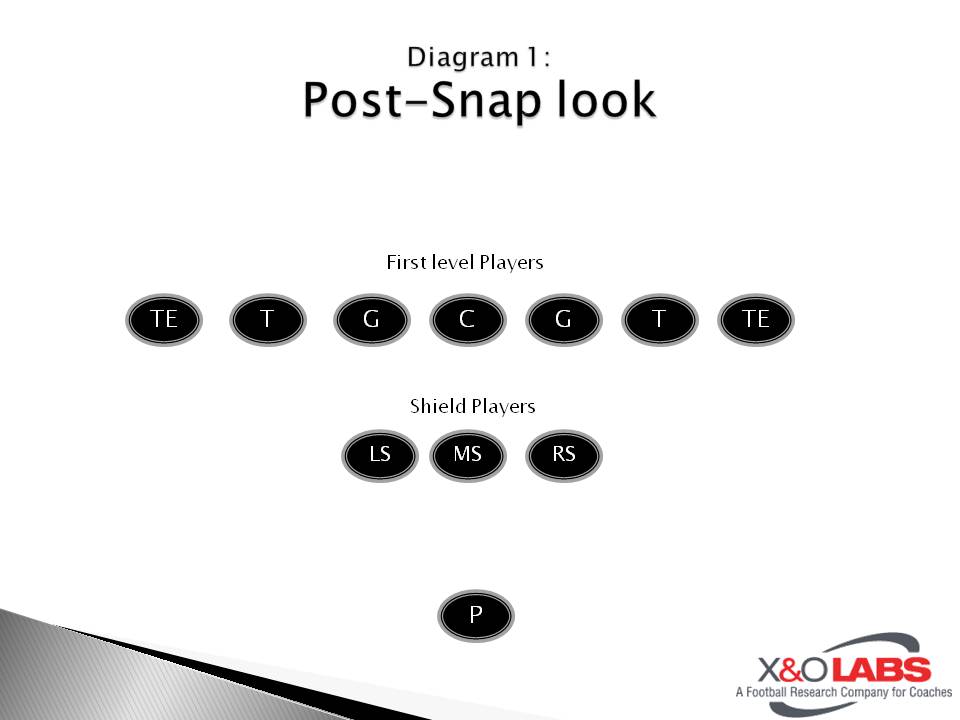
If you watched all thirty some odd bowl games season, we’d wager that a game didn’t go by were at least one team didn’t use the shield punt formation (Diagram 1).  The fact is it’s all over the college landscape.  While we couldn’t trace its roots or origins (although we do have Bill Stewart from West Virginia reflecting on it below) it spread quickly, at least in the college ranks.  As a high school defensive coordinator in central New Jersey, I have yet to face it in the last eight years – and as X&O Labs started to conduct its research on the topic, I’m glad I haven’t.  But I have a gut feeling that once this report gets circulated, it will only be a matter of time before it rears itself in my neck of the woods.  Truth is there is no reason it shouldn’t.  What you’ll see below is research garnered from hundreds of coaches supporting the idea that the benefits of utilizing the shield punt scheme far outweigh the risks.  As Keith Herring, the head coach at Brentwood High School (MO) told us, “We were leery when we put it in.  Until you see it happen you’re hesitant.  But it really does work.”   You’ll also find that for the first time in this report, X&O Labs published actual comments from the survey that we released last week (I should point out that we only asked coaches who have experience either running the shield punt or returning punts against the shield punt to complete the survey).  The reason is simple: Our coaches loved to discuss this scheme, and they want to sell you on it, because they are sold on it themselves. 
Among the hundreds of coaches we surveyed, 72.8 percent use the shield punt exclusively in their package.  The only situation they won’t is when punting from their own end zone.  So feel free to contact them to learn more about it, they won’t hesitate to return your call.  In fact, our coaches were so outspoken about the advantages of running the shield punt, we listed them below for you:

Advantages of Using the Shield Punt Formation:

  • Better coverage down the field: The shield punt puts seven players in coverage at the snap of the ball, all seven players on the line of scrimmage.  Although the numbers may equate to traditional style punts, the presence of the middle shield players and a three yard spilt along the line of scrimmage allows all players up front to get off into their lanes immediately and cover the kick.
  • Quicker snap to kick time: 70.6 percent of coaches average between 2.0-2.4 seconds per kick using the shield punt.  Reason being almost all of them teaches a two-step release:  Step with the non-kicking foot then boot the ball out of there.  Distance isn’t a priority as much as speed and coverage when using this style.
  • Simpler blocking assignments: We found this to be the most simple of them all.  While most use man schemes, we detail examples of both in the report.
  • Better personnel on the field: The coaches that took this survey were intense about special teams, 39.1 percent were special teams coordinators at the high school and collegiate level.  So, they don’t think about resting their best players on punt.  Bill Stewart, the former coach at The University of West Virginia called it “the best play in football.”  You’re about to see why.
  • Keep defenses “defensive” and not “pro-active:”  We got this philosophy from Travis Walch, the special teams coordinator from the University of St. Thomas (MN), who switched to the shield punt in ’09 because he was sick of defending it.  We’ve found coaches will mix a rugby (rollout) style with a conventional drop and kick style.  Which means many will put one of their better athletes at punter – and that makes the variable for a fake rise through the roof.  Instead of defenses getting revved up to block their kick, they were paranoid of the fake.  Some coaches shared their fakes with us, but that will be revealed in another report (when we can verify who they play!).
  • It’s nearly impossible to block: This may surprise you, but of all the coaches we spoke to personally when developing this report, only one of them had one blocked and it was because of a poor snap.  Sure, we did interview a few coaches who thought they had this scheme figured out (in Case Four) but because of all the issues a shield punt presents, the majority of defensive coaches would rather set up a return than a block.

Get Instant Access to X&O Labs’ Full Library of Game & Practice Video – Plus Full Length Reports and Interviews. Click Here!

Case 1: Rugby Style, Drop Back Style or Both?

When executing the shield punt, it seems you have three options with the punter.  After reaching out to coaches, here’s what we found:

  • 50.0 percent use a pure drop and kick punter with a two-step release
  • 47.5 percent will mix drop and kick with rugby rollout styles
  • 2.5 percent exclusively use a rollout and kick

It seems that you either have an athlete that can handle the rugby style or you don’t and in turn can’t run it effectively.  Whichever style you choose, it’s important to point out the depth of the punter.  According to our research 66 percent of coaches aligned him at 14 yards.  Herring, whose teams hadn’t had a punt blocked in three seasons, toyed around with the idea of using a rollout style.  “We played around with rugby, but in the four years I’ve ran it, most guys were better just traditionally punting it so we stayed with it,” said Herring.  “I like two things about it:  we get down the field quickly because we’re so spread out; also a lot of people don’t know how to line up to it.  Guys line up so wide on the tackles that they take themselves out of the play.”

Walch, at the risk of being too predictable decided to vary the launch points of his punter from rugby to drop back.  “Why not try to use two different launch points on punt?” he says.  “You do it on offense and defense so why not special teams?  By doing this, the defense doesn’t know if he’s punting out of pocket or directly behind long snapper.  You’ve already put doubt in the punt blockers minds.”

Walch used to have his punter roll either way and decide on his own accord when to punt.  Now, he coaches up the steps.  “We had two or three that were blocked because he had indecision on whether or not he should punt it,” said Walch.  “Now we have designed steps, side shuffle, turn his body (for three steps) and on number four he’ll punt it away.  We don’t have a four and a second launch point like we used to.”

West Virginia, under Bill Stewart, used primarily a rugby style roll.  We had to reach back into the annals of our research (we saw Bill speak at a clinic two years ago) to reflect on how he coaches his punters.  “He (the punter) needs quick hands, eyes and feet, I don’t care if he punts the ball 40 yards,” said Stewart.  “It will be no higher than 10 feet off the ground because that will give the ball a good roll and it’s what we want.  If we give a “read” call to the punter, he reads the end man on the line of scrimmage.  If that defender rushes, the punter punts the ball.  If he back off, the punter runs the ball.”  Sounds simple enough, but the success of the play, like any other offensive scheme, starts up front.

Case 2: First Level Blocking

We’ve heard through our sources that the majority of coaches who bought into the shield punt scheme use man-blocking principles.  It turns out that was correct.  According to coaches that took our survey the results were as follows:

  • 47.5 percent of coaches teach a man blocking principle across the line of scrimmage
  • 28.3 percent of coaches teach a zone blocking principle across the line of scrimmage
  • 24.2 percent of coaches combine zone with man principles across the line of scrimmage

Since all man blocking may be the easiest to teach, we’ll start there.  While most coaches surveyed employ a three-yard split between blockers, Herring takes a five-yard split between his tackle and his tight end in his shield punt.  This means the defenders that line up on his gunners are more than eleven yards from the ball (Diagram 2).  His blocking rules are simple, his players don’t block.  “If a guy is head up on us, we just try to get an inside release and go through him,” he says.  “We are runners, not blockers.  You’re going to rip through a guy and get to your landmark in coverage [we will explain his landmarks later]. If there is no one on your inside shoulder we just clean release because our shields will pick them up.  If they are on the inside shoulder, we will get a piece of them just to tie them up.”

Chip Dale, the offensive coordinator at Eastern High School (IN), does have a count system for his protection, but it’s done from the outside in with his perimeter blockers.  Similar to Herring, Dale feels the whole concept of using the shield is to cover, not block.  But Dale emphasizes more of a zone blocking scenario. “We don’t identify the four inside threats, we identify the three widest threats,” says Dale.  “The block angle is better for those guys to get around the wall.  Edge rushers are the fastest kids, if you get an extra step on the punt or the snap might be there in time you get a chance to block it. The whole goal is to make their angle impossible, or throw their angle off of it.”

Against true 10 men down schemes, Dale will have his outside player identify the three widest threats, which the tight end, tackle and guard (he calls them by number) are responsible for.  “We will make a man or zone call based on their alignment.  The tight end is responsible for number one outside.  If he’s clearly the widest threat, it’s a man call.  That’s it. The number two man (or tackle) block number two and our number three man (guard) will block number three (Diagram 3).”  Where it gets complicated is when return teams line up in stacks, which we found is a usual scenario against shield punt teams.  “If there is threat of a guy changing his lane, if you got guys stacked or if it’s more of a traditional defensive set up with levels than we’ll zone it and attack the widest threat to our zone.  In this case, number two will ask if there is a guy that can replace two.  If there is then he’ll make a zone call.  In the zone call, the same rules apply.

If there is a two man stack on number one then he’ll have a zone call based on threat (Diagram 4).  But as soon as there is a zone call, we’re all on a zone call because you never know what’s going to happen.  Counting them off helps make it cleaner for the kid to think about.  We don’t worry about the guys in the middle.  We have our shield guys there to absorb the blow.”

Similar to offensive lineman (which Dale’s front line players are not, they are mainly defensive backs and linebackers) Dale teaches a bucket step to block the zone. “You want a target so that the blocker runs his body through the outside shoulder of the rusher. We get as deep as possible. We tell them to do whatever they have to do to get out there.  However deep you have to step, get it done.   Whatever we have to do to get our body in line, that’s what we’ll do.  Once they get to the outside shoulder of defender, it’s done.  We don’t worry about the inside path.  If he crosses our face, he can’t block the punt. That’s our philosophy.  Not only have I slowed them down with time and distance, but the shield is in the way.  Using this scheme, I’ve never seen a punt block- only on a dropped snap or a bad kick.  You don’t see blocks based on scheme, it’s based on poor execution.”

Walch mixes his protection between a man side and the zone side, for reasons he expounded to us (Diagram 5).  “Usually the man side of the protection is going to block out and leave the A gap players running free.  I’m comfortable with that on one side, because if we let two guys go in A-gap than two guys can man up on those two.  But I’m not comfortable allowing both A gap run through’s.  Now you have four rushers against three defenders.  I wanted to zone off one guy. To the zone side we protect inside gaps. So now if a fourth guy is coming through it won’t be an A gap fourth guy, it will be wide edge defender which is a wider rush.  Let’s put them in a situation where they have further to go to get to the punt.  If I put my zone side to the left, I know at a minimum I can always roll my punter on the rugby away from the fourth man.”

Walch will tighten his splits on the zone side, but he still fans his protection based on the alignment of defenders.   “We start from the outside in with our count.  If my end doesn’t have a guy in a three point stance head up or outside of him, he lets him go. We don’t believe that he can get there with three yard splits unless he’s in a sprinters stance.  If he has a guy there, he calls him his number one.  Our number two will take the next biggest threat inside him and the guard will take three.  So, basically we’re fanning out.  We tell our guys to read demeanor.  Just because he’s in a three- point stance doesn’t mean he is rushing.  We just pick the foot up and put it down.  If he’s not rushing, you’re out of there and in coverage.”

Walch call his zone side a “shuffle gap” technique.  Our call side foot is back.  We make one complete shuffle with shoulders square. Once that happens, we’ll have someone declared to our gap.  Their job is to forward their helmet across and hold the line of scrimmage as long as they could and then release downfield.  If guys put two in a gap on the zone side, they could still get leakage but it’s not clean.  You can’t get beat across your face.  It’s not a straight line to the punt.”

As far as the man side goes, Walch teaches what he calls a “blunt” technique.  Our call side foot is back with a two-point stagger stance.  All you’re doing is picking up and putting down that outside foot.  Once your guy attacks you, you’re just going to blunt him.  You’re not trying to block him; you want to just blunt him enough to take him off that line.  We’re trying to slow him down.”

To see Walch’s shield punt scheme footage at the University of St. Thomas click below:

Get Instant Access to X&O Labs’ Full Library of Game & Practice Video. Click Here!

Case 3: Shield Level Blocking

Among all of the elements of the shield punt, it was the play of the three shield players that we were most intrigued by.  We wanted to know how to teach 17-22 year old kids to sit back on their heels and absorb a blow from a defender running full speed ten yards away.  Our first mistake was assuming that these shield players sit back and “sponge up” on blocks, this wasn’t the case according to some coaches.  We were also wrong in thinking shield players were ten yards from the line of scrimmage.  As it turns out, 67 percent of coaches line their shield players up less than eight yards from the line of scrimmage.

So, rather than compound our mistaken assumptions, we detailed below specific coaching points given to the shield players by the coaches that responded to our survey:

Chris Fore, former head coach, Capistrano Valley Christian High School (CA)

“They are to have their heels at seven yards (from the line of scrimmage) and they are stepping one yard UP, and one yard IN at the snap of the ball to form a shoulder to shoulder shield. They are NOT to chase anyone that comes wider than they are. They are to use their outside hand (left hand for the far left guy in the shield and right hand for the far right shield) to pop anyone coming to their right or left, trying to sneak by. They aren’t to leave the shield to block them, just get them off their sprint by popping them.”

Trey Henderson, University of William and Mary

  1. Must have a “Back against Cliff Mentality” Do Not Step Back!!!
  2. Wait until your man is 6 inches in front of you.
  3. Press your inside arm into the inside number.
  4. Cannot give an inside seam.
  5. Do Not Lunge at your man. Keep your weight underneath you with a good base. Work up into your man on contact.

Kreg Kephart, head coach, Gaithersburg High School (MD)

“They must step up to five yards after the snap clears, otherwise they risk being knocked back into the punter by a rusher. They must first take any immediate inside pressure. If there is no inside pressure, they next look for other penetration.  These players need to be your most physical athletes because they must absolutely be able to step up and stop a charging defender and then be able to get into coverage. Usually good sized linebackers, fullbacks, defensive ends or athletic linemen fill these positions. In addition, we like to have a FB type in the middle, because a direct snap to him is one of our favorite fakes.”

Keith Herring

“We line up six yards from the ball.  They are blockers first and they must step forward not backwards.  We try to get shoulder to shoulder.  We look for A gap players first.  If we don’t have A gap players, we go for B gap players.  The most pressure comes in the A gap pressure.  If we have four A gap players against three shield players we will pick up the most inside guys.  If they can get a piece of the other guy and bump him off that’s all we need.”

Chip Dale

“The shield is going to absorb four guys up the middle, time and distance hurts them.  We take care of the three outside guys with our outside guys (mentioned earlier).  They are at 10-12 yards.  You want to get extremely low like a squat and get both hands up like a bench press. You want to catch them with your hands.  You got three guys standing there with their hands together.  You basically want to teach them to get on the balls of their feet so when they make contact, their body just rolls back onto their heels like a squat.  That’s all we need, a stun.   They are a yard in front of the block point.  It’s just enough so that the punter could get the ball over them.”

Travis Walch on the Rugby Rollout

“We teach our shield just like RB’s in sprint out.  When we go rugby style, we cut our splits down and they all pin block down (Diagram 6).  Our near side up-back kicks the first thing out off the edge, while our middle up-back runs the edge and zones it off.  We form a nice pocket.  That’s where we fit it up and kick it.  The back-side of that is the zone side and it never changes.  They always do the same thing, we ask the back-side shield guy to hinge it and pick up any leakage.”

Researchers’ Note: You are reading the summary version of this Research Report. To access the full version of this report – including the corresponding Statistical Analysis Report featuring the raw coaching data from our research – please CLICK HERE.

Concluding Report

Like any other report we’ve compiled, our goal is to get coaches to consider implementing a particular scheme or at the very least find ways to adjust what they’re doing based on the material we present.  We also would love to hear about what you’re doing.  We asked a number of coaches to submit a clinic report on an aspect of offense, defense or special teams with the intent of contributing their knowledge to other coaches in the profession.  Because of an enormous amount of responses, we’ve set a deadline of January 27th to submit these.  Look forward to reading what you do.

Questions or Comments? Mike Kuchar will be available to answer your questions or respond to comments.  Please post your question or comment in the “Comments” section below and Kuchar will respond shortly.

Copyright 2012 X&O Labs

Tags: , , , , , ,

25 Responses to “The Efficiency of the Shield Punt Scheme”

  1. DVSport Fan 24 January 2012 at 8:49 am #

    I’ve seen this punt formation many times on Saturdays and I have always wanted to see a breakdown of it done so thanks X&O Labs for putting this together!

  2. Chris 24 January 2012 at 2:54 pm #

    Great article, Ive wanted to see this broke down for a while as well … Had no idea Bill Stewart was one of the originators of it

    just one typo in it

    Its West Virginia Univ…. not Univ of West Virginia

  3. ballcoach79 24 January 2012 at 5:32 pm #

    Great article! this is very informative and helpful!

  4. mark 4 February 2012 at 12:42 pm #

    Just curious, how does this work if your long snapper doesn’t snap it very hard?

    • Chris Fore 24 April 2012 at 6:55 pm #

      Sorry to say this, but he has no business being a long snapper. Change personnel?

  5. Jay 13 February 2012 at 12:01 am #

    How would some of these coaches change up their scheme when punting off their own 1 yard line?

    • Chip Dale 21 February 2012 at 8:10 am #

      When I am pinned in there are many variations that can be used. The most common I use is either Punt Close, or Wings Punt. Both have similar philosophies and are Max Protect formations, but arrive at it differently. Both sacrifice the instant coverage of the shield in exchange for ensuring a successful kick.

      In Wings all the splits are reduced to 6 inch splits, and the second shield is moved. The outside men move up to become wings, and the middle becomes a personal protector. This formation essentially uses the field goal rules to protect the kick. All the men in protection follow the same rules outlined above for the second shield men (low squat, hands in gaps, on balls of feet, absorb the rush, etc.)

      Punt Close is not so much a pinned in punt, as it is a Max Protect from anywhere punt formation. Punt Close tells the front shield to reduce their splits to 2 feet, and protect their inside gap. These players take 2 hard steps into their gap and deliver a 2 hand punch into that gap (must maintain square shoulders to ensure a sound protection). It also tells the second shield to change their responsibilities. The outside men on the snap come straight ahead (targeting the outside hip of the tackle) and then usher the first outside threat up the field. The middle man stays in as a personal protector cleaning up any middle trash. This can be used when you are pinned in and don’t expect a rush, but has some risk.

      I have also still used the basic shield when pinned in, and did not expected a rush. This is a real roll of the dice, because the angles and distances are really short and much easier to obtain a block. However you will not have a return (because of the instant coverage) if the ball is off, so it’s a matter of how much are you willing to risk in exchange for the field position.

      • Josh 11 September 2012 at 8:20 am #

        Chip, Why would you want to kick out the end man on the LOS if your punter is rolling out to the call side and holding on to the ball as long as possible to help coverage?

    • Chris Fore 24 April 2012 at 6:57 pm #

      Quite honestly, I’m at the high school level, but I wouldn’t change much. The only thing I would change would be the placement of the shield. Heels at 5 yards from ball instead of 7. That way, there is more space between them and the kicker.

  6. Alex 20 March 2012 at 11:01 am #

    You’re going to let 4 guys go in the A gaps if they put 10 men on the line? That will never work. Why would you let the nearest blockers go with numbers instead of leaving the outside gunners that are 16 yards away from the block point?

    • coach cuellar 24 April 2012 at 12:18 pm #

      Most pressure comes from the B gaps, surprisingly. You want to funnel guys into the shild, but if you have a fast guy go untouced from the b gaps you can get it blocked.

    • Coach Dale 11 September 2012 at 9:46 am #

      It sounds quite crazy. Like most things that are non-traditional many people are skeptical. However three men can prevent 4 men from running forward quite effectively. This is a big reason why you always see OL type players here. Added mass and strength in the wall. Like Coach Cueller explains, a quick man through B gap has a possibility to block it. No more than any other punt scheme though. The most likely outcome for a block is him coming around the wall and blocking it. However he will not go through it. If he is athletic enough to run through A/B gap, circumvent your wall, and still block it well I would put my money on the fact that he will block any punt you are putting out.

  7. John Bowers 20 March 2012 at 11:17 am #

    Clemson,Utah,Bowling Green,W.Va.,Texas AM first 5 schools to use this punt

    • Chris Fore 24 April 2012 at 7:00 pm #

      A and M had two blocked in back to back years in their biggest game of the year – vs. University of Texas. Here’s why:
      Most colleges “angle punt” and so their kids take off at an angle off the ball towards where the kick is going. In back to back years, they never blocked the widest kid on THEIR right. He came free and clear and blocked the kick, two years in a row! Once, inside their own 20, totally changed the entire game.
      I’ve taught this punt different for the last 10 years. My front seven guys are taking a step laterally on the LOS, and then blocking “through their zone” on the way to the football. The guys on the right side are taking a step with their right foot and blocking through the zone on their right side. The guys on the left doing that for the left. We funnel everyone to the shield up the middle. You never leave a guy untouched on that front line like A/M did both years. Using this approach, that Longhorn would never have come close to the kick!!! But their R3 took an INSIDE release and let that kid come.

  8. Jud Keim 20 March 2012 at 8:49 pm #

    Outstanding article. Have run the shield the past 2 years…and no..Have not had one blocked (2 tipped balls via jumpers over the sheild). My quick thought was the coverage assignements. Because you are already in wide alingments…your lanes ‘are set’…We simply tell all releasers to “Inside Shoulder Force” the ball…It sorts out real time..Puts multiple leverages on the returner. The Shield guys become 2nd level fold players..same thing though – inside shoulder force…”Widen – Locate – Compress”. It’s the same concept we teach Kick Coverage players…all overlaps. We also have a 1-step punter and great snapper…we averaged 1.9 last year! Thanks again…would like to see more ideas on how to block a punt vs this. We got one last year off a decent scheme.

    • Coach Dale 11 September 2012 at 9:53 am #

      I love the idea of inside shoulder force, as well. Especially when you are talking to multiple kick coverage units. However with my HS kids I prefer the simple question proof approach on punt. It’s something they don’t have to think about and we can just rep the landmarks quickly. Then in other drills rep open field type tackling.

      In regards to blocking I have had a lot of success with teams who use their wall men almost like personal protectors. Typically they will put 2 on one side and 1 on the other. I overload the 1 man side and then put my blockers on paths to attack the single man’s inside and outside shoulder. Make him take one of the two. As Coach Kuchar mentioned hurdling the wall in a wall scheme was very popular, but is now illegal. Like I told Mike in my interview, I’ve only heard of one punt ever being legitimately blocked without an execution error when a NFL kid at D3 circumvented the wall.

  9. C Reddy 5 April 2012 at 8:49 pm #

    Thanks for the article. Does the snapper just snap and release? I’m just wondering about releasing the 4 guys that the 2nd level shield guys have to pick up. Does the snapper pick one of the A gaps to get a piece of before going to the ball? Also are there other good supplementary articles on this topic? I’m more intrigued but not fully convinced yet. Thanks

    • Mike Kuchar 6 April 2012 at 8:28 pm #

      Coach,
      Snapper doesn’t touch a soul, in fact neither do most of the first level players. Many coaches just teach them to get down field and make the tackle. The way the punt is set up, the ball is out before any type of penetration- it’s now illegal for college players to try to “leap over” the shield players. We are in the process of putting out more info on this- I’m currently at the Naval Academy and they have a terrific drill they do with it. We will post within a couple days.

  10. Colin Hart 5 September 2012 at 1:31 pm #

    With the Zone/Man combo that St. Thomas runs, what determines which side of the line is zone or man? Is it predetermined?

    • Mike Kuchar 11 September 2012 at 9:38 pm #

      Great question, coach. Coach Walsh didn’t want to reveal which side is man or zone- and understandably so. From what I gathered, it is all based on game plan.

  11. Daniel B 3 October 2012 at 1:18 am #

    Back when Texas in the early-mid 2000s was leading the nation in blocked kicks most years, we always ate this stupid 8-3-1 formation up. Instead of getting the rusher who was initially standing still, 2 extra guys now had to block a guy with a full head of steam.

  12. Andy 22 January 2013 at 1:27 pm #

    Its funny that you start the ariticle saying “If you watched all thirty some odd bowl games season, we’d wager that a game didn’t go by were at least one team didn’t use the shield punt formation”

    What I see every bowl season is team in the shielf punt formation getting punts blcoked. Every year.

  13. bill johnson 25 January 2013 at 1:42 pm #

    The problem with the shield punt comes from the type of players you use in the shield spots. Many times they are Oline types who have no chance of being effective when it comes to making a tackle. If you use Lber type kids then it makes sense.


Trackbacks/Pingbacks

  1. SHIELD PUNT Part 3 – GETTING DOWN FIELD TO MAKE THE TACKLE! « CHRIS FORE - April 9, 2012

    [...] some more reading about the Shield Punt, you can also read this article via xandolabs.com.  They quoted me in this article which came out in January.  X and O Labs does a great job with [...]

  2. ANATOMY OF A BLOCKED SHIELD PUNT « COACHFORE.ORG - November 13, 2012

    [...] The Efficiency of the Shield Punt by X and O Labs [...]

Leave a Reply

Please fill the required box or you can’t comment at all. Please use kind words. Your e-mail address will not be published.

Gravatar is supported.

You can use these HTML tags and attributes: <a href="" title=""> <abbr title=""> <acronym title=""> <b> <blockquote cite=""> <cite> <code> <del datetime=""> <em> <i> <q cite=""> <strike> <strong>