



Play-Action Pass Game Out of Diamond Formation

Posted on March 5, 2012 by in Offense

By Mike Kuchar

Research Manager

X&O Labs

Two weeks ago, X&O Labs released its report on the Diamond formation run game.  While we realized its balanced, three-back structure can produce a myriad of problems for defenses to defend the run, all of which we detailed in the prior report (click here to read the full report), we had no idea how many coaches were gashing coverages by putting the ball in the air.  Although the Diamond formation may provide some generous one-on-one matchups on the perimeter (a key ingredient for the quick game) we’ve found that the majority of coaches will employ some play-action concepts in the formation.

Since the Diamond is still a relatively novel idea (although the T-formation old timers may tell you differently) the following report does not contain a ton of statistics and figures.  It’s more of a collection of examples from coaches that reached out to us and wanted to pass their ideas along to you.  It’s verbatim, straight from our surveys.  As if that is not generous enough, they’ve even offered to answer any questions you may have.  So when you’re done reading, feel free to ask questions or make comments below and these coaches will respond.  By the same token, you’re always welcome to share what you’re doing at any time by contacting us (I can be reached at mikek@xandolabs.com).

We’ve broken down the Diamond formation play-action game into the following categories:

  1. Power Pass: Since we found the gap scheme was the most used run scheme out of the Diamond formation, we figured we’d start there.  The intent is to put pressure on the perimeter of the defense.
  2. Iso Pass: This is based off the isolation run scheme with the intent to get behind the interior of the second level defenders.
  3. Boots/Nakeds: For those that have more athletic QBs running the system, this scheme provides a duel threat run/pass option on the perimeter.
  4. Specials: Some changeups that can provide big play opportunity.


Case 1: Power Pass

Play Concept (Power Pass)

Contributor: Mike O’Donnell, Rush City High School, Rush City (MN)

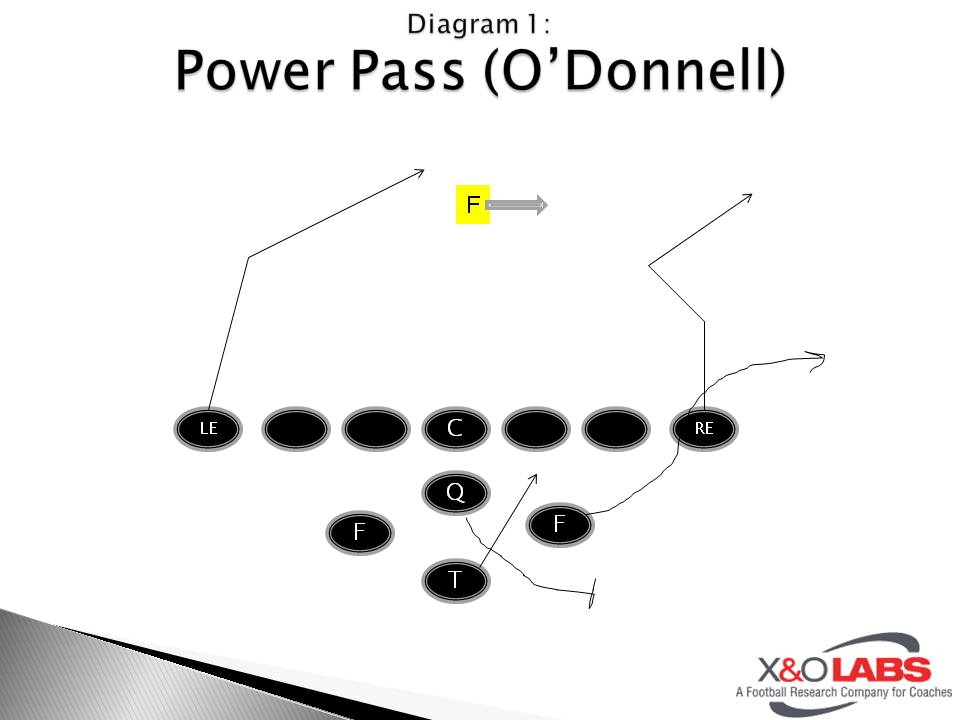
The most production pass action we have employed from the Diamond set has been to fake our power/lead play.  We’ll look for the play side end who runs a post-corner route. At the same time, our near back who would be a kick out blocker on the defensive end in our lead play, would slide out into the flat after faking a block on the defensive end. This power/lead action tends to freeze the defense and keeps them committed to stopping the off-tackle action. By forcing the defense to check for the run first, we then get a two-on-one look with our play side end deep to the corner and our near back in the flat.  At the same time, our backside end runs a post and looks for a deep opening in the middle of the football field. If the free safety moves out to help cover the post-corner route by the play side end, the post is wide open to the backside end. Diagram 1.
Play Concept (Y Hide)

Contributor: Dan Higgins, Cocoa Beach High School, Cocoa Beach (FL)

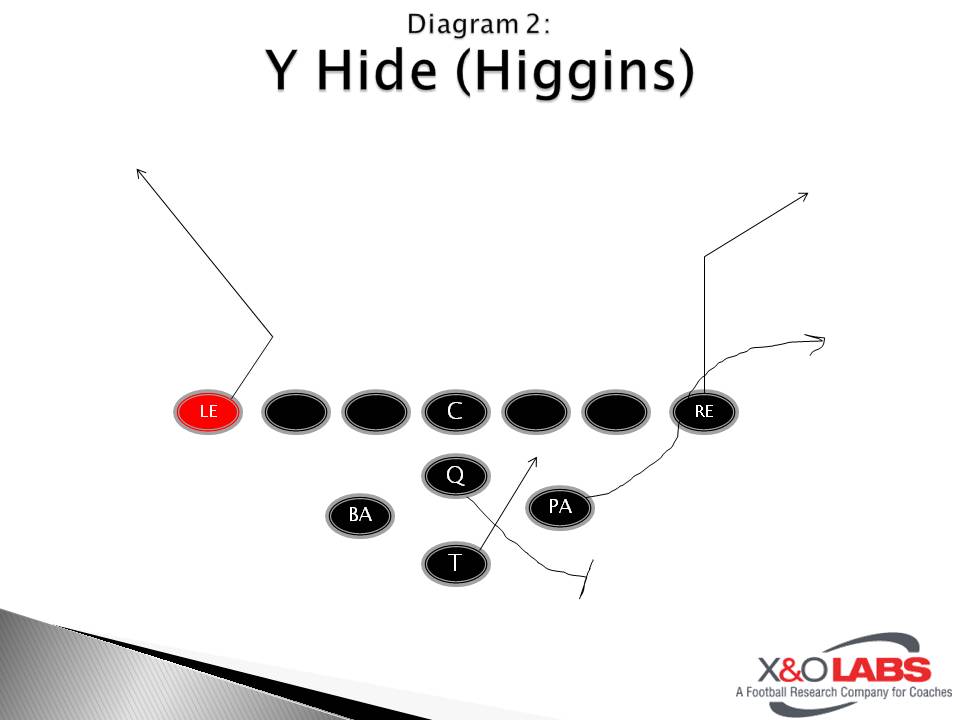
  • QB: Play action the tailback to the play side TE side.
  • TB: Fake the dive and block the DE to the outside.
  • PA: Run track to the outside of the DE and run an arrow route to the goal line cone.
  • Play Side TE: Release to the inside and get cone in the corner of the end zone.
  • Backside TE:  Release inside and hide for a 3 count and then get to the backside cone (flag route).

QB Check Downs: (diagram 2)

  1. Look and pump play side
  2. Get depth and throw to the backside TE
Play Concept (Flood Concept with Tail Motion)

Contributer: Dan Higgins, Cocoa Beach High School, Cocoa Beach (FL)

On this play, the backside A-back will go in deep motion to the play side and will run a swing pass to the play side (5 yard depth from LOS). This causes the perimeter defensive player to take him in the fats thus producing a flood route by having three players on the play side.

By flooding the play side, the Corner and the Free Safety will have to pick up one of three routes:

  1. Swing route by the backside A-back
  2. Arrow route by Play side A-Back
  3. TE on a Flag route to the corner of the end zone

When we run tail motion, the backside TE will change his release to the inside.  He’ll hide three seconds and then get to the back of the end zone (goal post), to replace the free safety once he has rotated to the flood routes.

FACT: Over 10,000 Coaches Get X&O Labs Emails Every Tuesday Morning.  Sign Up Today – It’s FREE! Enter Your Email in the Box in the Right Hand Margin of This Page >>>>>> Above our Facebook Fan Box.  


QB Check Downs: (diagram 3)

  • Read play side corner to see if he plays swing or arrow route in the flats
  • TE on flag route
  • Backside TE on a post route


Case 2: Iso Pass

Play Concept (Iso Pass, two tight ends)

Contributor: Clayton Hillyer, Former Head Coach, Newington High School (CT)

Our best pass concept was play-action off the isolation fake where the play side TE (#1) ran a corner route, the lead HB would run to the flat, and the backside TE ran a drag.  Our concept was a naked bootleg, which was essentially a 1-man route with the TE, although the other backside TE dragged across the field.  More often than not, the QB kept on the bootleg and gained good yardage.

Rules:

OL:

  • PAP BOB blocking
  • NT and BSG have Mike

TB: Great fake and block Sam LB; if Sam doesn’t blitz and the OL doesn’t need help, release to about 5 yards deep over the OT.

H: Shuffle motion like iso; on snap block back for Will LB; if Will drops, stay in and protect the QB’s blindside

Z:

  • Take a path at $; try to make eye contact so he thinks it is a run
  • Veer off at the last second and run your arrow to the flat to about 4 yards
  • If you are at the sideline and uncovered, sit down
  • If $ blitzes you must chip him first with inside shoulder and then get your head as you are the hot receiver

Y: Punch 7-tech toward OT and then release to run corner route; stem at 10 yards; cannot get hung-up

X:

  • Punch the Will to give H a chance to get in position
  • Run crossing route behind Mike and Sam to about 10-yards deep when over the other TE
  • Don’t be in a rush; let Y clear first
  • Find the open grass; if the curl player is wide helping on the corner route by Y, sit in the window; vs. man or open green grass, keep gaining width and depth; try to keep your vertical spacing between Y and Z

Get Instant Access to X&O Labs’ Full Library of Game & Practice Video – Plus Full Length Reports and Interviews. Click Here!

QB:

  • Check $ for blitz pre-snap; Open to playside and execute great fake
  • Get eyes on $ as quickly as possible after the fake as you drop; he is your hot read
  • If there is no blitz, read high to low: Corner, Cross, Arrow, Check Down
  • If no one is open or there is pressure, run or throw it away


Case 3: Boots and Nakeds

Play Concept:  (Inside Zone Read Boot)

Contributor: Reid Evans, Offensive Coordinator, Central College (IA)

Protection:

  • OL: Block inside zone read. You must not go further than 3 yards down field.

Receiver Assignments:

  • X: Normal split, run comeback at 15 yards. Against C2, run streak.
  • Z: Work across the field to the opposite pylon. Against C2, dig at 12 yards, staying parallel to the LOS. Work to get into QB’s vision.

Running Back Assignments:

  • FB: Attack the outside shoulder of the backside DE to sell run. Run flat route working to a spot 4 yards.
  • T: Run jet-sweep fake. Keep pads low and run hard to the sideline to sell the run.
  • R: Fake inside zone read. Immediately after making your fake, bend toward the play side, away from where the QB is booting. Keep pads low to sell the run.

QB Assignment:

  • Fake inside zone read, get depth of 9 yards, boot naked, and come to run. Look for FB off movement of flat coverage to X off movement of corner coverage. If forced to pull up, hit Z.


Play Concept (08 Naked)

Contributor: Camiel Grant, Newton High School, Covington (GA)

  • OL:  Slide protect to the call side. Show run for two steps. Responsible for call side gap.
  • Z: Outside release 9 route. Work from middle of the numbers to side line.
  • X: Inside release, then get vertical to 10 yards, post at 10-12 yards.  MOFO split the safeties.  MOFC get over top of FS.
  • Y: Aim for the C-gap and take best available release (inside or outside of EMOLS).  Must go vertical for the first five yards.  Run crosser climbing to 12 yards then get flat.
  • B: Work through the outside shoulder of EMOLS.  Chip and get to the flats no deeper than 5 yards.
  • A: Fake the outside zone, carry outside arm high and tight, run wheel route.
  • QB: Fake outside zone, execute naked/boot footwork.  Progression:  Green grass=run!, Peek 9 ball, Flats, Crosser.


Researchers’ Note: You are reading the summary version of this Research Report. To access the full version of this report – including the corresponding Statistical Analysis Report featuring the raw coaching data from our research – please CLICK HERE.

Concluding Report:

The Diamond formation will continue to be a topic of study this off-season as well as the subject of an extensive research report that will be conducted and released right here at www.xandolabs.com within the coming months.  As always, we welcome any new ideas or suggestions on potential research topics.

Questions or Comments? Post your question or comment below and the coaches who contributed to this report will respond.

Copyright 2012 X&O Labs


Tags: , , , , , ,

Trackbacks/Pingbacks

  1. Vintage Video: Roots of Shotgun, Wildcat, and No Backs Offenses | X&O Labs - June 10, 2012

    [...] research report on the formation that could be seen here: Diamond Formation Report #1; and, Diamond Formation Report #2. I simply call it the Inverted Wishbone.  But, many in the press were fascinated with this [...]

Leave a Reply

Please fill the required box or you can’t comment at all. Please use kind words. Your e-mail address will not be published.

Gravatar is supported.

You can use these HTML tags and attributes: <a href="" title=""> <abbr title=""> <acronym title=""> <b> <blockquote cite=""> <cite> <code> <del datetime=""> <em> <i> <q cite=""> <strike> <strong>