

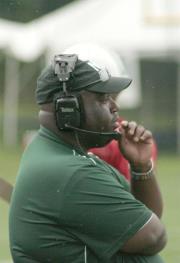
7 Steps to Effective Defensive Game Planning


By Kevin Loney


Head Football Coach

Nichols College (MA)


I’m truly honored to be able to write an article like this for my peer coaches.  These game-planning philosophies are a product of a number of stops along my coaching career and a lot of trial and error.  Thankfully, I’ve been blessed to spend time at all three levels of NCAA college football, and I’ve had the distinct honor to learn at the feet of some of the game’s best.  Through all of this, I‘ve learned that the most important reality is that at the end of the day, football games are won by players, rather than schemes.

Step 1: Evaluate Talent                                                                                                                                                           

With that in mind, I firmly believe that the even before we can put our marker on the grease board, our first responsibility of coaching is to be able to objectively evaluate talent. We must figure out objectively what our players can & can’t do.  We must also be able to assess objectively what the opposition’s guys can & can’t do.  What are the match-ups?  Where are the mismatches?  How can we exploit our pluses?  How can we hide or protect our minuses?


Next, we must figure out what do our guys need to do to improve their weaknesses.  Then we must ask ourselves, “can we get it taught and how long will it take?”  For example, I was blessed to spend two seasons at the University of Notre Dame as an intern and a Grad Assistant with the Offensive Staff under Coach Charlie Weis.  After the 2007 season, we took the time to go through each snap of the season and evaluate our scheme, what did we do well, and what did we struggle with.  We had a protection called 64 Scan.  It was a pretty in depth protection concept and we as a staff felt that after watching it we should de-emphasize it in our playbook. After listening to us, Coach Weis felt that it was a concept that we would need in 2008.  Our job was to take almost our entire spring and training camp practices to get it re-taught and practiced enough that it would not be a liability.  After all that work and practice time, it went from being our worst protection to one of our best.

Step 2: Establish Philosophy                                                                                                                              

Once you have evaluated your talent, you can begin to establish a defensive philosophy.  Here at Nichols, we start with a few simple premises:

  • First, we believe that we must dominate 1st down and first and possession & 10 snaps.
  • We want to get the offense off schedule, which means putting them in long 2nd downs which we believe lead to low percentage 3rd downs, which lead to punts.  We coach our players that it is the job of the defense to take points off the board. 
  • We must turn TD’s into FG’s, turn FG’s into long FG’s or failed 4th down attempts, and finally force punts instead of FG’s.

Step 3: Come Up With Answers                                                                                                  

Our coaching staff believes that at the end of the day, it’s our job as coaches to have and create answers to the challenges presented by the opposing offense.  We take time during off-season as a staff to come up with answers to the things we don’t see often.  For us, it’s the Triple Option, Wing-T, Spread, and Pistol offenses.  For High School coaches, it may be the Single wing, or the Double Wing.  I challenge my offensive staff to do the same with defenses they don’t see often like the 3-4, 3-3 and various types of zone pressures.  Once we’ve put our answers to these issues together, we try to use late pre-season practices and possibly spring to introduce these answers to our players, we don’t think that the first time they see them should be in preparation for the game.


Read More

WR Drills – CW Post (Part 2)

Video Length: 11:02

Read More

WR Drills – CW Post (Part 1)

Video length: 14:46

Read More

Developing a 7-Technique C Gap “Bully”

Defensive Ends: Using Your 7-Technique to “Bully” Tight Ends

By Jared Pospisil

Defensive Columnist

X&O Labs

Jared Pospisil, Defensive Columnist, X&O Labs

Researchers’ Note: Please welcome Jared Pospisil to the X&O Labs’ team.  Coach Pospisil is the Defensive Coordinator at Union High School (IA) and will now also serve as a monthly defensive columnist for X&O Labs.  His previous report on his Cover 4 Run Read Drill is one of the most read and commented reports in X&O Labs’ history. As you’ll read in his first column below, Coach Pospisil brings a unique perspective to solving problems on the defensive side of the ball.  And every month, Coach Pospisil will bring you unique – but proven – ways to better your defense. Please welcome Coach Pospisil by posting in the Comments section below.

One of the main things that has helped our defense improve over the past few years is the development of our defensive end play, particularly as it pertains to maintaining a solid C gap defender.  What we do with our defensive ends is not groundbreaking; still, we are happy with our “Bully” method that we use to package and teach a particular DE concept in our Over 43 defense.

Ironically, it took getting a thumpin’ in the first round of playoffs four years ago to bring about the positive change.  In that game, we played Crestwood High School (IA), a very physical, two-tight end, full-house backfield offense, whose main plays ran off the tight end’s rear.  Crestwood routinely caved down our DEs so quickly that our linebackers and defensive backs did not have an opportunity to fill before the running backs were already five yards downfield.  The next day, as I replayed the events of the game over and over in my head, I became sick thinking of how effective the off-tackle play was for our opponent and how ineffective our defense was at stopping it.  Then I realized our defense faced many teams in our district whose main offensive plays ran off-tackle, and we did not defend that play well all year!  From that day on our defensive staff set out to find a way defend the C gap better.

At the time, we utilized two 5-technique (outside shade of the offensive tackle) defensive ends in our Base Under front (Diagram 1).  We taught them to key the ball and attack the outside shoulder of the offensive tackle across from them at the snap.  Unfortunately, this left them extremely vulnerable to a down block from just an average tight end, notwithstanding some of the bulldozer types we regularly faced in our district.  After talking to a few college coaches and watching film of a number of college and professional games, we decided that we would ask our DEs to widen to 7-techniques (inside shade of the TE) in an attempt to give our defenders a better chance to fight off the down block.


Still, we did not want to tell the defensive end “just line up wider.”  Instead, we set out to develop a concept labeled with a tag word for our new DE play, a tag word that would encompass the required alignment, key, responsibility, and technique.  We settled on the term “Bully” because that is what we wanted our DEs to do to TEs: We expected the DEs to harass, beat up, and knock down TEs.

The “Bully” Technique:

7-Technique Defensive Ends

Now, any time our DEs see a TE align to their side, they are to utilize the Bully technique.  We tell our Bully DEs to align their outside nostril to the TE’s inside nostril, as close to head-up as possible without actually being head-up (Diagram 2).  The DE’s movement key is now the TE, not the ball.  We used to be a ball-key team.   However, we felt that when the DE looked down at the ball or the offensive tackle he was an easy blind side target for the TE.  Now when the DE focuses on the TE, he has a fighting chance to maintain the C gap.

Read More