

Delaware’s Drive and Pivot Concepts Out of Empty Formations


By Jim Hofher,

Offensive Coordinator,

University of Delaware

Editor’s Note:  X&O Labs’ Senior Research Manager, Mike Kuchar, was granted exclusive access to the University of Delaware’s Offensive Coordinator, Jim Hofher.  During this meeting, Coach Hofher, revealed his drive and pivot concepts out of an empty formation. If you have any questions or comments, please post in the “comments” section below this report. 


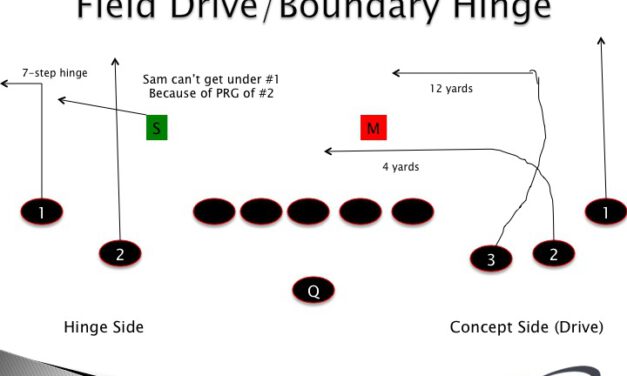
Field Drive/Boundary Hinge Concept (Diagram 1)


Philosophy:

  • Three-man side executes “Drive” Concept
  • Two-man side executes “Hinge” Concept
  • Formationally, the three-man side should be to the field, while the two-man side will be to the boundary.   This can be altered based on game plan.

Field Drive Rules:

  • #1 Receiver: Takeoff route; get on top of defender.
  • #2 Receiver: Underneath route; get under the movement key (which is the play side inside linebacker).  Must fight his way under the wall.  Target is at four yards. Create an oblique angle. Must take an outside release to gain width and also to create a passive rub against man.
  • #3 Receiver: Outside release and run an in route try to gain no more than four yards width with his release to 12 yards.  Twelve yard speed cut and becomes an automatic rub.

Boundary Hinge Rules:

  • #1 Receiver: Seven step hinge (out route) or convert to a go route against a low cornerback. Against press technique, the hinge will convert to a go.  In Coach Hofher’s words, “The QB doesn’t get off of the X side just because it’s press, but we will get off the X side if there is safety help.”
  • #2 Receiver: “Protection Release Go (PRG)” trying to pin the expanding coverage player.  The goal is to protect the hinge route so that the flat player cannot get under number one.   He must rip to outside hip of defender.  As Coach Hofher states, “He may rub or initiate contact while running.  We want alley players to be unable to affect hinge.”

 Video:

Read More

14 Keys to Efficient, Effective Practices


By Sonny Wolfe,

Quarterbacks Coach,


McGill University

Sonny Wolfe, Quarterbacks Coach, McGill University (Former Head Coach)

Key 1: Prep, Plan & Prepare

Great preparation is required to manage efficient and effective practices. To an extent each week is a race against time. The team – either yours or your opponent’s – who best uses their time, will give their athletes a much needed advantage. To insure that your practice time is maximized, planning is of the utmost importance; a daily meeting is required – input from all staff should be encouraged.

Key 2: The Right Kind of Communication

The next step is to get the “practice plan” into everyone’s hands ASAP (assistant coaches, players, student managers, equipment managers etc.); this will allow everyone to arrive at practice “ready to go.”  Players should have structure explained to them in pre-practice meetings, and the plan should be posted for the players.

Key 3: Set Clear & Specific Practice Rules

Practice rules and tempo must be clearly defined and understood. Every program must determine rules based upon their philosophy, level and needs. All rules are designed to have the most efficient and safe practice environment. Here’s a list of our rules:

  • Tempo Options:
    • LIVE – regular football rules (might consider QBs not live)
    • THUD – live on the LOS – modified rules elsewhere – see below
    • TEACH – walk through or ½ speed drills with “form contact” if any
  • Stay Away From the QB: Defenders if they beat their man, or are unblocked due to an assignment error, do not try to get to the QB – if they beat their man – run past the QB. The QB is the key to most offenses – we need our best guy healthy game day.
  • No Collisions: No one follows through on a potential “knock out shot.” Examples – if an offensive player has a potential “ear hole” block he will break down and insure the defender cannot make the play, but will not “blow him up.” Defenders will not unload on a defenseless receiver.
  • Tackling: No offensive player is taken to the ground. If the ball carrier (running back or QB on run plays, or receiver on completed pass plays) is met head on, the defensive player will form tackle him. If the tackler is approaching on an angle he will tag the ball carrier’s near hip – this will help our pursuit as the B.C. will continue downfield.
  • All Players Stay on Your Feet – Always: Offensive players will not cut block; defensive players will not leave their feet to make a tackle. No player will leave their feet to jump on a fumbled ball in the backfield – this includes fumbled QB/Center exchange, QB/RB fumbled exchange and poor Gun snaps. The lone exception is a receiver attempting to catch a pass.
  • No Grabbing Jerseys: Grabbing jerseys encourages poor technique and can result in twisted ankles and knees.
  • No Bull Rushes: We prefer that our d-linemen work on other techniques to improve their skill level. This will also help keep the QB “clean.” In order that our O & D linemen work some bull rushing and pass protecting against the bull rush; we do work some during 1-on-1 periods.
  • No Batted Balls: Having d-linemen bat a ball during a team period is a disruption – we encourage our D linemen to raise their arms, forcing our QBs to find a throwing lane. During defensive periods, you might allow batted balls; however by so doing, you cannot evaluate the coverage as effectively.
  • Stay Away From the QB:
  • Stay Away From the QB: Yes – we repeat this message twice.


Read More