
DL Head Up Techniques in an Odd Front

By Mark Miller, Defensive Coordinator, Katy High School (TX)

Editors Note: Coach Miller has 18 years of coaching experience with 7 years on offense and 11 years on defense, with the last 5 years as a Defensive Coordinator / Assistant Head Coach at Taylor HS a 5A school in Texas. He has experience at both the high school and college level.  In 2011, was recognized as Katy ISD’s Boys Sport Assistant Coach of the Year. Miller has his Bachelor’s and Master’s Degrees from LSU. 

This article is intended to define fundamental techniques for defensive linemen within an ‘Odd Front”.

Why employ an Odd Front Philosophy of defense?

  1. It maximizes Personnel by Body Type, Athletic Ability and Mental Capacity.
  2. It puts direct Pressure on the Center
  3. It’s a balanced Defensive Structure
  4. It’s availability and Ease of ‘Move’ / ‘Stem’, ‘Stunt’ and / or ‘Blitz’ Packages.

Our first consideration is always our personnel and what we have to defend. An inherent and unique characteristic of high school football is the fact playing football is voluntary. High school coaches cannot ‘recruit’ or ‘draft’ for a specific offensive or defensive scheme. Coaches place athletes in positions where they can maximize their abilities and help the team become successful. Some of these determining considerations are:

  1. Body Type: height, weight and composition
  2. Athletic Ability: strength, power, speed, agility and reaction time.
  3. Mental Capacity: Cognitive function to physical application / action.

Within those position assignments, the scheme applications are designed as a coordinated help for the individual players abilities. We define our ‘odd front’ through a strength declaration and an identification tag word. The ‘strength declarations’ can be made in seven different ways:

  1. Tight: to the Tight-End
  2. Open: opposite from the Tight-End
  3. Field: to the wide side of the field
  4. Short: to the short side of the field
  5. Over: to the RB in the ‘Shot-Gun’
  6. Under: opposite from the RB in the ‘Gun’
  7. Strong: to an offensive lineman / side

Base Alignment

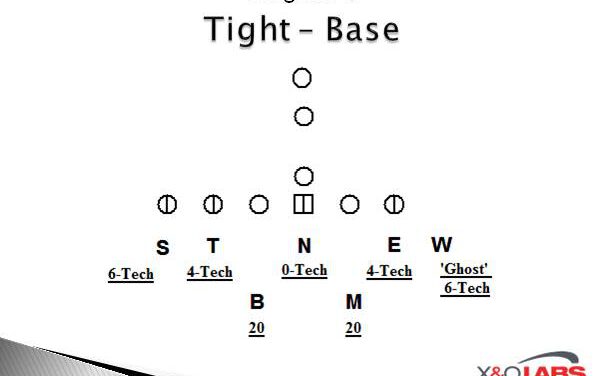
The term ‘Base’ defines the front alignments (Diagram 1).


‘Base’ tells the noseguard to align head-up as a “0” technique on the center. The DT will align to the call as a 4-Technique. The Buck LB will align as a 30-Technique to the call. The DE will align away from the call as a 4-Technique. The Mike LB will align as a 30-Technique away from the call. The Sma LB aligns on the Tight-End as a 6-Technique and the Will LB aligns opposite the Tight-End as a ‘Ghost’ 6-Technique. It is a balanced structure.

The presence of the “0” technique noseguard and two ‘30’ backers over each offensive guard places three defenders over either A-Gap. (Diagram 2)

The ‘Odd Front Structure’ places ‘Direct Pressure’ on the first person handling the football, the center.

The foundation of teaching / coaching these head-up techniques is physicality. Assuming a head-up alignment increases the likelihood of having to take on an offensive lineman’s initial charge right down his midline. This places a greater emphasis on the defensive lineman understanding and applying proper pad level, striking out of the hips with a blow and separation.

Read More

Villanova University’s “Peek Concept”

By Mike Kuchar, Senior Research Manager, X&O Labs

Last spring, as I was making my spring practice tour through the northeast, I stopped in at Villanova to sit down with offensive coordinator Sam Venuto and wide receiver coach Brian Flinn, a longtime friend and devotee to X&O Labs.

After documenting an up tempo and intense practice (click here to read our spring practice report from our visit to Villanova) Coach Flinn enlightened me about a pass concept he was starting to toy with, which he called his “Peek” play. According to Flinn, it was a scheme modeled after what Dana Holgerson was doing at West Virginia that replicates the same action as Villanova’s bubble screen concept. It’s a play-action scheme that targets the middle or inside linebacker by “peeking at him,” and taking advantage of how he defends the run-action of the single back zone read in trips formations.

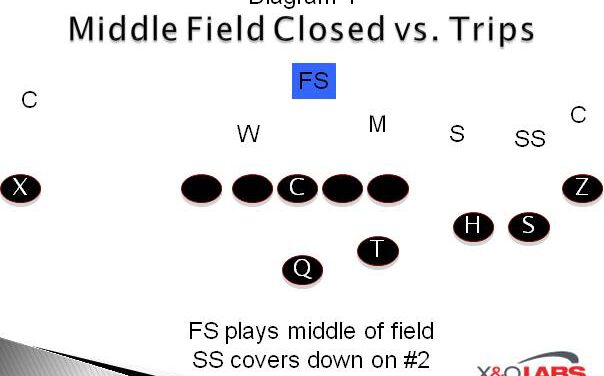
According to Flinn, against his offense, defenses will either close the middle of the field (Diagram 1) or push the outside backer to the trips side to stop the bubble screen (Diagram 2). Because so much of what Villanova does offensively is laterally, defenses don’t fly up the field on them. So, the Peek Concept is what he uses to put the Mike LB in a bind.


Peek Concept Receiver Rules (Diagram 3):

  • Z receiver: blocks the MDM (Most Dangerous Man) on the edge, just as he would in a bubble screen concept.
  • S receiver: bubble screen path. Flinn calls this the Nike Swoosh (because of the way the emblem curves is similar to the path the WR takes).
  • H receiver: runs a stick route. If the ball is on the hash, he gets on the outside edge of the hash. It’s a vertical, no stem, inside hitch. Three times with the outside foot, which equals five total steps, should get him to five yards. His goal is to make the Sam LB travel and Mike LB widen. “The further we get from the Mike, the more open we get,” says Flinn. “If we widen our split enough- we tell him if the ball is on the hash he’s on the outside edge of the hash. If the ball is in the middle of the field, he will split the difference between number two and the tackle but he will plus two (get two more yards outside). I’ll never tell him he’s too wide. I tell him to get as much space as you can.”
  • X receiver: run a backside slant.

Read More

Using Motion and Shifts to Gain Offensive Advantages


By Mike Garner

Offensive Coordinator

Broken Bow High School (NE)

It is something that exists at every level of football: An opponent has one defensive end who plays the run better than the other, one corner who is better against the pass, etc. When you are a power-running team, defenses may simply load up against you to stop the strong side power play. You can go to your counter game, but then the defense has succeeded in dictating to you what you are going to do offensively. So, how do you gain an advantage when you are undersized along the line?


One possible solution to these problems was made clear to me after listening to a clinic by Coach Dan MacLaughlin of Wayne State College (NE). Much of what I’m about to explain about using motion and shifts to gain an advantage and dictate to the defense stems from both that clinic and subsequent conversations I had with Coach MacLaughlin, and I would be remiss if I did not give him credit for causing me to think about how I have used motions and shifts with my teams.

First, I want to discuss how we have used motion in our offense to create an advantage. We have employed the following types of motion: Sprint (across the formation) and Crack (motion back to the ball) by the wide receivers; and Fly (left) and Storm (right) motion by the running backs, either the fullback or the tailback.

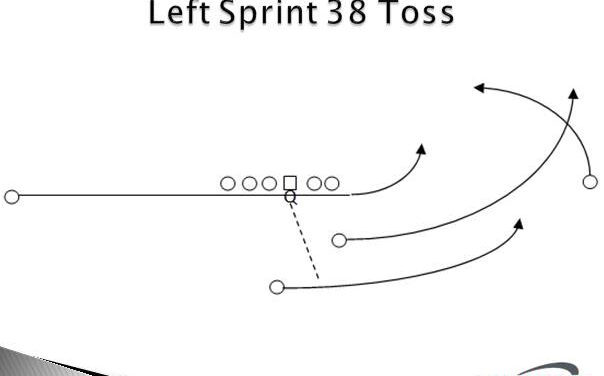
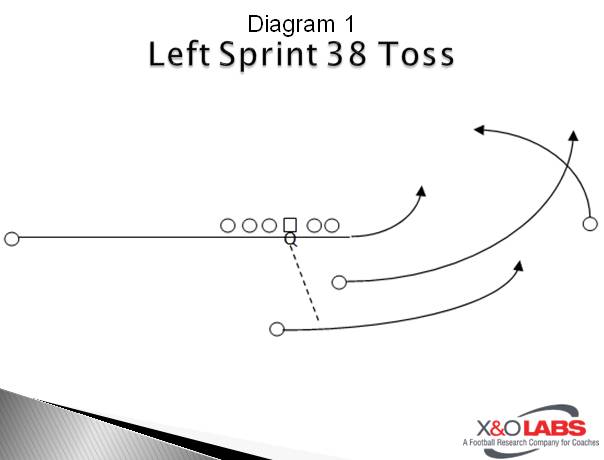
To illustrate how wide receiver motion can be used to create an advantage, I want to illustrate four possible scenarios using Sprint and Crack motion.

In Diagram 1, we use Sprint motion to give us another blocker on the perimeter and outnumber the defense to that side of the field. We could do the same thing by pulling a lineman, but the advantage of using receiver motion is that our extra blocker will be at the point of attack when the ball is snapped. Of course, the disadvantage is that the defense simply has to chase or shift with the motion with their safety or linebackers to get the numbers back in their favor.

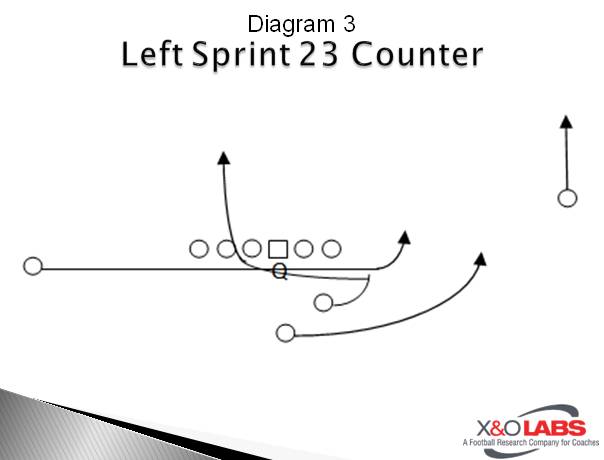
Diagram 2 is one response to a defense that adjusts its strength in response to motion. We use Sprint motion again, but this time we want the defense to flow with it so we can run a counter play back in the direction from which the motion came. The two keys to using motion to set up a counter play like this is that the receiver going in motion has to “sell” his fake just as much as the tailback as to sell his. Obviously, the action of the tailback is the second key to making a counter off motion work.

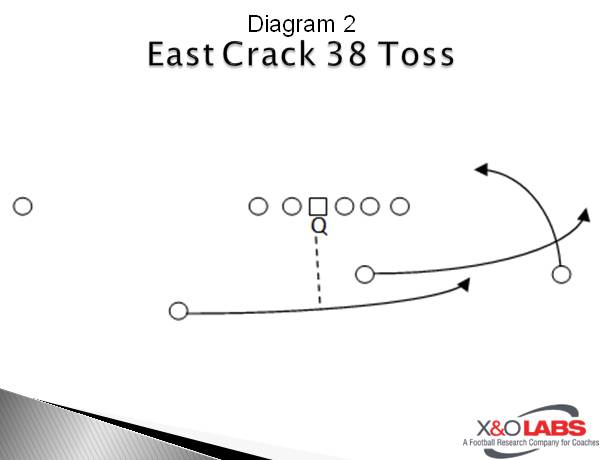
The scenario in Diagram 3 is no doubt one of the most utilized forms of motion: having a receiver go in motion and crack back on an outside linebacker/safety who comes up hard to play the toss. Against teams that play a wide 9-technique with their defensive end, we have even, at times, crack blocked that player. Obviously, your receivers have to be well coached to avoid a block in the back call and one of the most common things we have seen opponents do is to have their outside linebacker turn his back to the receiver as soon as he sees the motion coming. Still, if you have receivers who are physically aggressive, using crack motion can enable you to get out on the edge of the defense quickly.

Again, we want to have a counter off of Crack motion, and Diagram 4 shows a play that has been very successful for us over the years. Once the defense has seen the toss play run off of Crack motion a few times, the defense begins to flow very hard toward the motion as soon as we show it. Faking a hand-off rather than a toss does not seem to hurt the effectiveness of a play we call Stretch Boot Pass. We could also run the same counter play shown in Diagram 2, but the advantages of Stretch Boot Pass are that we usually see at least one receiver running uncovered across the field and the quarterback also has the option to pull the ball down and run.

Read More