DB Drill Article – Training Corners to Read the 3-Step Drop

By Doug Langley

Head Coach

Avon Grove High School (PA)

Teaching your corners to read through the 3-step is a must, especially as the high school passing game gets better each season. I’ll start by asking this question: Do you want your corner to be able to react to the QB’s release on the 3-step drop and be able to tackle the hitch as it’s caught or even break it up? I know your answer would be “yes.” You can’t take away everything, but if you could stop it in its tracks you would be happy, right? As you work your coverages according to your game plan you know you’ll complete a hitch or a slant but if you can tackle it or maybe take it away completely, that could change your opponent’s thought process! If you teach your corners to read through the 3-step drop you will be more confident to leave your best corner alone on the backside of trips. You will also be more confident in taking away the 3-step drop when you are not in a Two-deep or in press coverage.

Once the QB is beyond the 3-step drop point the coverage dictates the corner’s drop. I teach the corners to read through the 3-step drop in Quarters coverage and in Cover Three. Teaching them to read through the 3-step drop is something that requires attention to detail but is not difficult to execute if it is taught correctly and consistently practiced.

Pre and Post Snap Technique

To teach the corners properly, you need to start with a good stance and back pedal. If you allow a lazy stance and back pedal, even if the corner gets a good read off the QB, he won’t be able to transition and make a good break.

Stance:

1. Narrow base; feet under arm pits 2. Outside foot up; toe to instep stagger 3. Weight on balls of feet; soul of shoes have full contact w/ground 4. Bend in waist; pads over toes 5. Bend in knees; hands at knee level 6. Hips square to the line of scrimmage 7. Eyes focused on the QB

Backpedal:

1. Controlled backpedal (3 read steps), while keeping the receiver in peripheral vision and reading the QB for an on or off the line of scrimmage read. 2. Upon the release indicators, snap head to receiver, transition (come out of back pedal) and close.

Read More

Pistol Two Back Zone Run Game

Kyle Schmitt

Head Coach

Atholton High School (MD)

Editor’s Note:  This is part 2 of Coach Schmitt’s series on the his Pistol Zone Run Series.  To view part one, click here.  Coach Schmitt has put together a 38-9 record through 4 years as the head coach at Atholton High School.  During that time, his teams have won 1 County Championship and appeared in three Regional Championships during that time.  Prior to his time at Atholton, Coach Schmitt served as a graduate assistant at the University of Maryland and as Tight Ends coach at St. Vincent College (PA).

This season we had a talented Slot Receiver/H-Back who allowed us to move from 1 to 2 back sets without changing personnel. As a No Huddle offense, keeping the same personnel on the field permitted us to constantly operate at a fast tempo. This also opened up the opportunity for multiple backfields and variations on our Zone Read Play as well as Power/Counter.

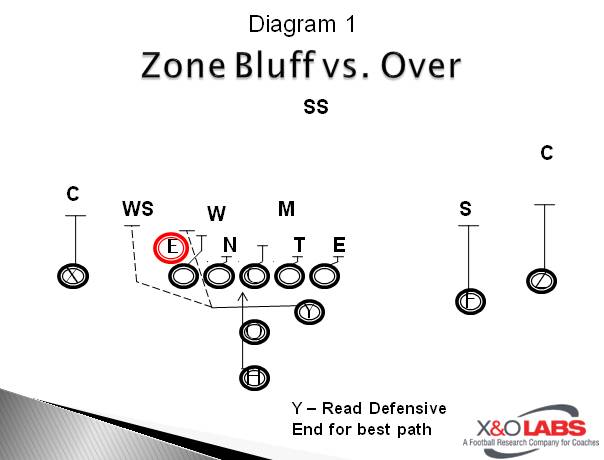
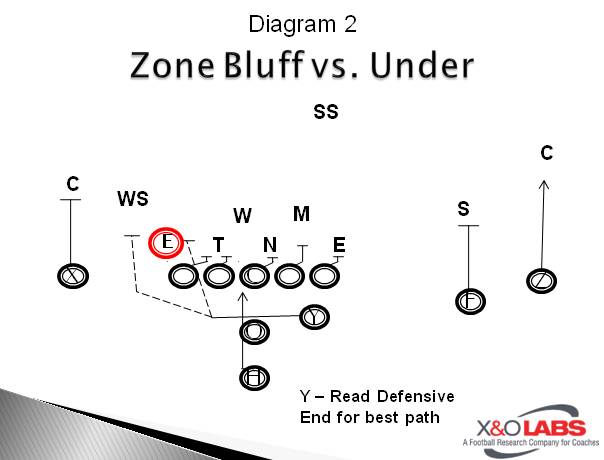
Zone Bluff

The Bluff action is very similar to our Slice play. The H-Back will cross the formation post snap but will avoid the EMLOS and block the first 2nd level/alley defender that he comes across. He is the lead blocker if the quarterback keeps the football. We are now reading the EMLOS. The Bluff play is beneficial versus aggressive defensive ends or teams that are squeezing their ends to take away the zone dive.

Blocking Assignments

Z

Block Most Dangerous Man (Bubble/Key Rules if attached to call)- If Bluff side block man over

Y/F

Block Most Dangerous Man (Bubble /Key Rules if attached to call)-If Bluff side block man over

X

Block Most Dangerous Man (Bubble /Key Rules if attached to call)-If Bluff side block man over

Y/F

Slot – Block Most Dangerous Man (Bubble/Key Rules if attached to call)FB – Always aligned frontside. Read the Defensive End. If DE up field get inside the End and block the most dangerous second level defender. If DE crashes bluff the End and block the most dangerous second level defender. If read is unclear bluff the End.

H

Zone Read FootworkRead – Frontside A gap to Backside A gap. 1st DL outside of BST is unblocked Read Player.  Run thru arm tackle

PST

Zone rules playside

PSG

Zone rules playside

C

Zone rules playside

BSG

Zone rules playside

BST

Zone rules playside

QB

Zone Read FootworkRead – End man on the line of scrimmageIf pull read follow the bluff players block.

Read More

8 Check Points for Improving QB Throwing Mechanics

By Ian Shoemaker Offensive Coordinator/Quarterbacks Coach St. Cloud State University (MN)

Editor’s Note:  Ian Shoemaker officially joined the Husky football coaching staff on July 1, 2008. This past season, Shoemaker directed the St. Cloud offense to average 426 yards per game, including 264 passing yards per game. The Husky offense also scored 35.8 points per game this past season. Shoemaker had been the offensive coordinator, quarterbacks and strength and conditioning coordinator at Baldwin Wallace College (OH) previously.

I consider this a tremendous honor to be allowed to share some of our ideas on QB play. I also appreciate X&Os Labs for providing this platform for coaches to share some of our tricks of the trade. What I am going to present is just what we feel is important to our QB position at St Cloud State University. Nothing that I am going to present here is revolutionary and all of the mechanic ideas and drills are things that I have pillaged from other QB coaches that I have had the opportunity to visit with or study. As you watch the film you will see our QBs are not perfect, far from it, however, we aspire to perfect these points of emphasis in every drill we do. I think that these check points and drills provide our QBs the best opportunity to produce and replicate a consistent release, which in turn gives us a chance to be an accurate passer. I just hope that there are a couple of ideas here that you might be able to use to improve your coaching of the QB position.

Check Point #1 = Carriage – Good Ball Control & Posture – Quiet Upper Body & Athletic Lower Body

The proper carriage sets the foundation for your throwing motion. A correct and consistent carriage will provide your QB the initial environment needed to produce a repeatable arm circle. Right handed QBs should carriage the ball comfortably on their right peck with elbows relaxed and pointed toward the ground. You do not want the ball too close to the body, nor extended too far from the chest. A ball held too close to the chest will impede the initiation of the throwing motion (i.e. Check Point #2 Short Circle). Holding the ball too far away from the chest will cause balance issues and tend to draw your QB’s upper body toward their toes. Upper body posture is very important to the carriage, throughout the drop back and any step-ups or resets, I would like to see consistent carriage and upper body posture. I feel this provides a consistent platform to trigger the throwing motion. Below the waist, I like to see an athletic knee bend and active feet. I really like the analogy I heard once of a duck gliding across the pond. Looking at his torso you would never guess how hard his legs were working to keep him moving forward. That is what I am looking for.


Coaching points: Quiet upper body and athletic lower body, separate the footwork from you upper body carriage and ball at peck.

To see the drills that Coach Shoemaker uses to drill QB Carriage, click on the link below:

Read More

Ron Zook: Bring the Pressure

Editor’s Note:  After leading both the University of Florida and the University of Illinois football programs, former head coach Ron Zook has taken what he plans to be a one-year hiatus from coaching before he returns to the sideline.  This off-season, he spent some time with X&O Labs’ Senior Research Manager Mike Kuchar discussing what he’s earned his stripes for as a defensive coordinator – the inns and outs of brining pressure. 

Part 1: Elements of a Pressure Defense

Ron Zook speaks exclusively with X&O Labs


MK:  Coach, can you talk briefly about your philosophy on bringing pressure?

RZ:  Systems nowadays have to be adjustable enough to adjust to your personnel.  One of the things I learned from Frank Beamer when we were together at Murray State is that when you’re getting after people, kids enjoy it.  They have fun.  There is no more read and react defense anymore.  You’re attacking.  Your defensive players are now on the offensive and they have fun doing it.  You have to be smart in what you’re doing by not giving up big plays, but he changed my philosophy defensively.  Football is an emotional game and you need to play with intensity.  Bringing pressure lets you do that.

MK:   How do you develop the “blitz makeup” of your defense?

RZ:  We always talked about what we called “blitz attitude.”  If you got people that are pressuring, they have to beat blocks to do so.  If you’re asking a linebacker to beat a running back – he needs to beat him.  It’s the same as a defensive back beating a wide receiver. We didn’t want to get beat.  When I coached the secondary, I always taught from a man coverage point of view.  If you can play man coverage, than you can play zone coverage.  What you’re doing in zone pressures is giving up a certain area of the field while attacking protections.

MK: What is your preference when designing zone pressures?  Which kinds of pressures are you most comfortable with?

RZ:  When you bring five people there are two things you can do: you can play a three deep three under principle like what Dick LeBeau and Dom Capers are known for by trying to get a guy free.  You’re trying to force an offensive lineman who is normally blocking a first level defender who then drops off.  This gets a guy coming free.  The QB’s are so good in the NFL and now in college they are going to get their line in the best protection.  You have to make the QB read on the run.  We got into the two-deep zone pressures while I was coaching with the New Orleans Saints.  I used to coach Joe Johnson who at the time was the best defensive lineman in the NFL.  We used to run our zone dogs and drop him in the flat.  So one day he turns to me and said, ‘look you’re paying me five million dollars to rush the passer not drop back in pass coverage.’  I told the head coach he had a point.  So we got into the two deep zone pressures to let our DL rush the QB.  You’re still bringing five defenders, but now you’re bringing the  four down and a second level player.  In college, we couldn’t play both three deep and two deep pressures because we didn’t have enough time to teach it.  If you teach everything from a man point of view- where you’re teaching where your eyes need to be and your leverage- you can teach any zone coverage.  Playing three deep and two-deep changes how you play the corners and safeties but it all depends on how much you can do.  If you choose to do too much, the less productive you will become.

MK:  How many pressures will you go into game week with?

RZ:  When I was in the NFL we had a whole bunch.  In college we may have 8-10 but they were “same as, same as” meaning that we had a lot in the repertoire, but you need to work the ones you are going to use the most.  You’re really putting in pressures to attack protections or take advantage of personnel that you may be superior than.  The ones you practice the most are the ones that are most successful.  I had to teach myself that less is more because that’s what your guys know in the heat of the battle.

MK:  How much does personnel play a part in how you’re bringing pressure?  Will you not run a certain pressure because of your personnel?  Are you more confident with the scheme or more confident with your players?

RZ:  I learned this at an early age at Murray State.   We had a terrific safety that could blitz and cover, so we used him.  The next year we didn’t have those same abilities.  So just because a pressure is good at one place, it doesn’t mean that it will work everywhere.  It’s all about putting your players in position to be successful- at any level.  Your systems must be flexible enough to put players in position to make plays.  Players will be more comfortable in doing their job that way.  If you have a guy that has a knack for getting off the ball, making guys miss and making plays on the QB, that’s the kind of guy you want to get free.  More often than not, that’s when you’re changing your blitzes from week to week.  For example, you may want a safety coming through the A gap or B gap based on the protection to get him free.

MK:  What are some proven indicators in determining pass protection when bringing pressure?

RZ: What you try to do is get an overall feel for their protection.  From there, you can disguise your coverage or your front where you can get their offensive line confused.  It’s fun to blitz- let those guys move around. Is the offensive line sliding?  Are they working a five-man protection?  Six man protection?  Go back and study the blitz reel of your opponent.  Once you see this, you can determine where the QB is trying to go with the football.  Find out where his hot reads are.  It’s easy to see if the back is free releasing or checking.  How do you get them to slide their protection?  It usually starts where the Mike LB is or where the center is counting from.  You try to disguise him that way.

Read More

Pistol Zone Read Variations

By Kyle Schmitt

Head Coach

Atholton High School (MD)

Kyle Schmitt, Head Football Coach, Atholton High School (MD)

Editor’s Note:  Coach Schmitt has put together a 38-9 record through 4 years as the head coach at Atholton High School.  During that time, his teams have won 1 County Championship and appeared in three Regional Championships during that time.  Prior to his time at Atholton, Coach Schmitt served as a graduate assistant at the University of Maryland and as Tight Ends coach at St. Vincent College (PA).

In 2009, my first year at Atholton, our football team was primarily based out of 21/11 personnel sets running both Zone and Gap Concepts. The success of that season encouraged us to stick with these sets that many would consider a “Pro Style” offense. In my second season as Head Coach at Atholton we started 2-2 and lacked any true cohesiveness or identity on offense. We had an underachieving offensive line and we weren’t correctly utilizing our skill players.  Our offense was a collection of plays, rather than a system. The Offense was diverse and gave defenses plenty to prepare for but little to truly worry about.

At the suggestion of my assistant Coach Jon England, I watched a Friday evening primetime game between Nevada and California. I was aware of the Pistol but gave it little consideration. I felt the short gun snap and deep tailback gave the offense minimal advantage. However, that night I came away extremely impressed with the Zone Read, QB Runs and paralyzing effect the misdirection had on the defense.  While it was easy to see that QB Colin Kaepernick was a special player he also played in a system perfectly suited to his skill set. Chris Ault’s system combined Wing-T, Veer Option and Spread principles to create a powerful run game. Needless to say Nevada games soon began to fill the Schmitt family DVR.

Our offensive staff began to experiment with the Pistol during practice in order to take advantage of our strengths.  We found the Pistol enabled us to better utilize all of our skill while simplifying our blocking schemes. The past two years we have evolved into a base Pistol offense. We are not exclusively Pistol because we feel the need to have additional backfield sets, formations and personnel groupings for different situations we will encounter as an offense. However, the Pistol has become the core of our offense and has been an excellent set to build upon.

Basic Tenets of Our Pistol Run Game

Zone Read

The base play in our Pistol offense is the Inside Zone Read. In 2010, we dedicated ourselves to running Inside Zone because our offensive line was struggling. The Pistol allowed us to feature this play from a variety of looks, especially Zone Read Play. The balance the Pistol provides allows us to dress up the Inside Zone from different formations and motions, without giving away our intention. Defenses struggle to cheat their backside ends, OLB’s and alley players to confuse the QB Read because of the possibility of the play coming either way.


The zone read has become the emphasis of our offense and the first concept we teach our offensive line. Instead of teaching a variety of plays we pride ourselves in blocking this scheme to a variety of fronts and pressures.

Quarterback Run Game

Over the past three seasons we have been fortunate to have talented Quarterbacks who are able to run the football. Moving the QB out from under center has opened up the QB run game. Each week we include QB Zone, Power, Counter, Power Read and Zone Read plays for our Quarterback out of Pistol. We found that running the QB was going to be a crucial element of our game plan versus top defenses. Some of our biggest wins and most successful offensive performances have featured our QB’s rushing upwards of 15-20 times on designed runs.

Base Run Concepts

The base run play of our Pistol Package is the Zone Read. Numerous teams from the NFL to High School football have adopted some type of Pistol backfield set, but very few of them are running a true Pistol Offense based on the Zone Read. We have very specific goals when running the Zone Read.

  1. Establish the Tight Zone play with multiple double teams at the Point of Attack. Our #1 goal is to run the Inside Zone when calling this play.
  2. Eliminate a defender by reading him. We will read the: 1. End Man on the L.O.S .;  2. 1st Defender from the Center backside; and, 3. backside LB’s.
  3. Create an open alley for the Quarterback Keep by formation or lead blocker. When teams dedicate their defense to stopping the hand off the QB will keep the football. We want to make sure that we have properly taken care of the alley in which the QB will run.
  4. Slow the downhill reads of the Inside LB’s with Bluff, Jet and Orbit action. We can also slow down linebackers by making them the read player.
  5. Establish constraint plays that do not allow the opponent to dedicate their defense to stopping this play.

We have the ability to run the Zone Read play out of any Pistol formation in our offense. The past two years we have concentrated on 10 and 20 personnel sets due to the lack of a true tight end in our program. Below are some of the ways that we run the Zone Read Play out of our 1 Back sets.

Read More

Utilizing the H-Back in Zone Schemes

By Stephen Rice Head Coach Richton High School (MS)

Editor’s Note:  Coach Rice is entering his fourth season as head coach at Richton High School.  Richton is currently coming off an 8-4 season, which was its first winning season since before 2004.  Coach Rice had completed a five game swing from last season, when Richton finished 3-8.

We are a run first pass second concept team. We run the ball almost twice as much as we pass it yet we do throw it enough to keep teams honest. We run the spread formation with a Nasty Slot or H-Back. I feel this gives us a chance to spread people out but at the same time gives us an extra blocker in the Box. Most nights we are playing teams that have better athletes when we step on the field, but believe this formation gives us the best chance to be competitive. We use multiple shifts and motions to try and gain an edge.

 Like most spread teams we use the inside and outside zone as our base run plays. As with most of us, the simplicity of running the zone and the lanes created by being in the spread formation are very conducive for us. The key for us is the H-Back. Most times this kid would be a fullback in traditional offense such as the I or Wing. He must be physical at the point of contact, but also must be able to move because he will be pulling and used in our play action and passing game.


H-Back Lead Zone

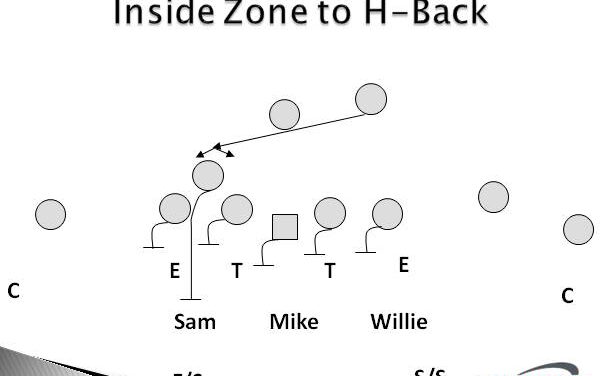
This is a basic zone concept but we use the H-Back to Zone up on the play side Linebacker We have two foot splits and our H-Back lines up splitting the stance of the Guard and Tackle. On the snap of the ball he leads up into the play side gap to the first second level linebacker that shows up. Our offensive linemen block the normal and traditional zone concept. They are responsible for the gap to the playside. (Diagram 1):

Read More

Monmouth University’s Take Concept

Watch a video tutorial of Monmouth University’s “Take” Concept provided exclusively by XandOLabs.com.

Researchers’ Note: Below this video are the PowerPoint slides.  You can scroll down to review these slides or just Click here to download the complete PowerPoint from Monmouth on their lethal “Take” concept.

Read More

The I Option Attack


By Ross Maddalon

Offensive Coordinator

Old Bridge High School (NJ)

Editor’s Note: Coach Maddalon is the offensive coordinator at Old Bridge High School. This past season, the Old Bridge Knights finished with an 8-3 record including a semi-final birth in the state playoffs.


When I joined the coaching staff at Old Bridge High School in New Jersey seven years ago, I was predominantly an I-formation guy. This was the offense I played in high school and ran when I coached my old high school team during college. I never really understood the concepts of “veer” and “triple” because none of the teams I was associated with had ever run them. At Old Bridge, however, I quickly became familiar with the triple option philosophy and its effectiveness.

What I saw at Old Bridge was a number of teams teaching their defensive ends to “bomb the mesh” and keep the offensive tackles/tight ends off of their scraping linebackers. Some teams were better at it than others. The well-coached teams were able to contain the option, and that left the traditional wishbone/flexbone team to answer with the “rocket toss sweep” or play-action passes.

For years I asked myself this question: “Why can’t we run the triple option from the I-formation?” By combining veer and midline with ISO/power/counter trey, an offense can really mess with the head of the defensive end. In 2011, we transitioned to the I-option attack and it paid off dividends.

Base Flexbone Option

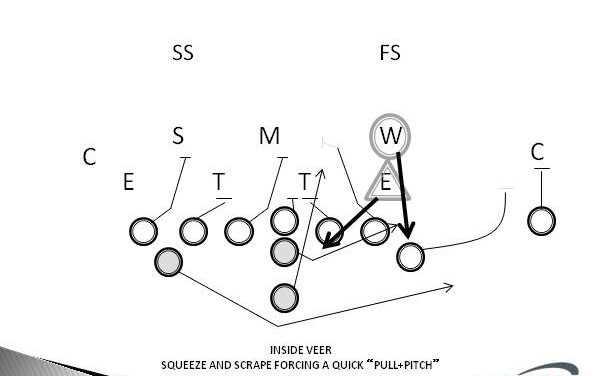
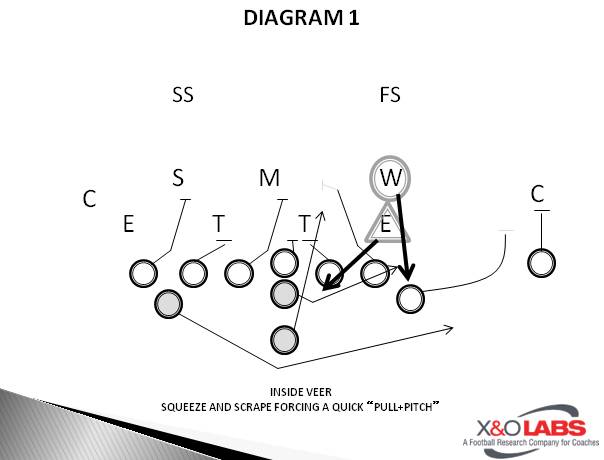
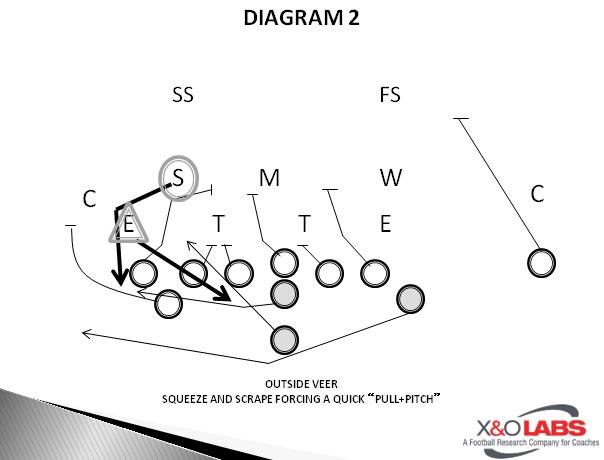
In the traditional wishbone/flexbone option attack, most even-front teams played the option with the “squeeze and scrape” philosophy.


Inside Veer (Diagram 1)

Outside Veer (Diagram 2)

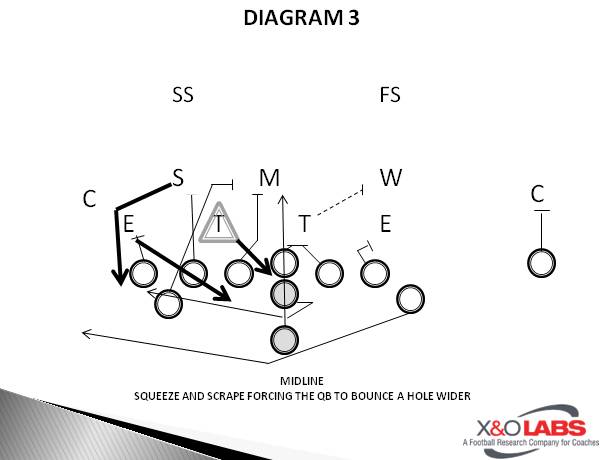
Even when we ran midline option (reading the 3-technique, double option), many teams decided to teach the defensive ends to slant hard inside and have the linebackers scrape for the quarterback, bouncing out a hole wider because of the slant-end.

Midline Option (Diagram 3)

Read More