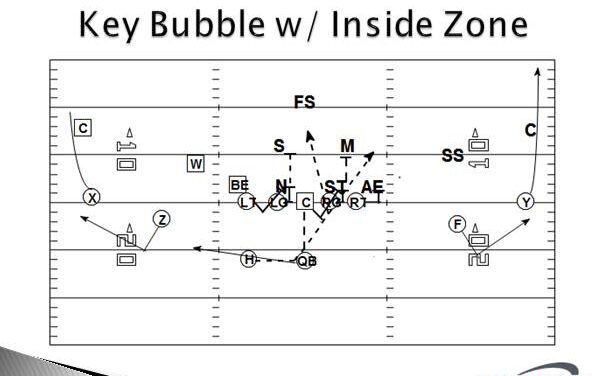




Split Flow Concepts That Break FB Tendencies
Curtis Peterson
Former Offensive Line Coach
Glenbard North High School
 Editor’s Note: Curtis Peterson recently was an offensive line coach at Glenbard North High School in Illinois. Before that, he was the runningbacks and linebackers coach at Crawfordsville High School in Indiana. He recently relocated to Indianapolis and he is the publisher of Strong Football. You can follow on twitter by his handle, @CoachCP.
I’ve been a big proponent of the I formation for many years. Until recently, I was opposed to the offset I formation though, because of the tendencies it offered a defense. I can now say I am a proud convert. At Glenbard North, we utilize the offset I formation out of 20, 21, and 22 personnel. To make the I formation more effective, you need to use the fullback to your advantage. There is a big belief that, besides maybe inside zone, if you follow the fullback post- snap in the I formation, he will take you to the play. There is also a common belief that you can look where the fullback is offset pre-snap and bump to that side because the offense will likely run it that way. As an offense though, you can use that myth against defenses. This report will show some of the ways that teams I’ve been a part of have kept defenses on their toes by being creative and efficient with fullback movement, both pre and post snap.
Split Flow Plays Using a Non-Crossover Path
We have split flow plays as well that we run without a crossover path. What is a crossover path? A crossover path occurs when the fullback needs to cross the middle of the formation to get to his blocking assignment. So in these cases, a non-crossover path occurs when the fullback does not have to go across the middle of the center to execute his block. In addition, split flow means the tailback and fullback are going in opposite directions post snap. I like split flow, non-crossover plays because the fullback blocks on the backside of a play. This way, any team that keys the fullback pre-snap as an indicator of the play direction will be out position post-snap. Also, because the fullback doesn’t have to cross the formation, if the defense keys him post snap, they will be flowing the wrong way.
Inside Zone
Maybe the most common split flow play is inside zone. Inside zone rules vary from team to team. Many teams have rules based on whether or not their play side teammate is covered and uncovered, and other teams have designed “tracks” to run no matter what on inside zone. In addition, some teams use a count system. Regardless, one similarity for most teams that run Inside zone is that the fullback is responsible for a backside defender. I’ve run Inside zone where the fullback kick outs the backside end man on the line of scrimmage (EMOLOS), and I’ve run inside zone where the fullback blocks the backside inside linebacker. Both schemes work well, as shown in diagram 1.
Diagram 1 – Inside Zone and Inside Zone BOB

Overall, Inside zone therefore presents the I formation with a great asset, the ability to separate the flow of the tailback and the fullback. Teams that spy the fullback will be flow the wrong way with their initial steps, often making the defender quickly “over flow” to recover. This is ideal on inside zone, because when the linebackers have their momentum too far to the play side, the tailback can cut up to the weak side A/B gap (commonly known as the “back door” on inside zone) for a large gain. For this reason, inside zone is top fullback tendency breaker.
Dart
Another split flow play is Dart. Dart borrows its blocking scheme from Iso, with the only changes being the tailback’s steps, and the fullback and backside tackle exchanging responsibilities. As you can see in Diagram 3, everything else is the same. The tailback sells weak side iso before bending back to the strong side. The pulling tackle would treat the pull in the same way the backside guard does on Power. Just like on Iso, the quarterback needs to make sure he doesn’t “push” the tailback off his path. This play is fantastic because it allows you to attack downhill quickly while giving the split flow. Also, because the initial same side flow of the backs, you will provide an “open window” that will likely get ignored by some linebackers where they would typically blow it up. It’s this open window that the tackle pulls into, typically giving him plenty of time to get to a second level defender.

 Rich Alercio








 If you believe that 3rd down offense is one of the most critical game situations your offense will face during the course of a game, then your offense must be fully made to understand the importance of this thinking. The thinking strongly goes along with the belief that you get what you emphasize. When we game plan, we start our game planning with the idea of starting with, what we believe, are the three most important facets of offensive play…..Base offense, Red Zone offense (which includes Goal Line offense) and 3rd down offense. We practice our 3rd down offense on Tuesdays, the first of our two heavy practice days (for a Saturday game). A major reason that we practice 3rd down offense on Tuesday is so that we will have two heavy practice days to practice against the blitz. Even if an opposing team’s defense is not a heavy blitz team, we must be sure that we are definitely ready to pick-up whatever blitzes we feel our opponents have shown. This goes along with a firm belief that you must be able to beat the blitz to win.


 Editor’s Note: Coach Marean has been with the Wayne Central High School Football Program (NY-Section 5) since the program started its first Varsity season in school history in 1998. Since taking over the football program in 2004, Coach Marean and his staff have made Sectionals 6 of the 9 years. He was named Coach of the Year by the league and also received the Finger Lakes Officials Coach of the Year Award in 2010. In 2011 they followed up with another League Championship and again he received the Coach of the Year Award by the League. In 2012 he was named to the Eddie Meath All Star East Coaching staff, of which they won with a dramatic field goal by one of his Wayne players. Coach Marean’s coaching record is 29-36 League (31-46 overall). Since implementing this new off-season point system, the past three seasons he has a record of 16-5 League (19-7 overall). Coach Marean resides in Hilton with his Wife Jennifer and two children, Andrew (8) and Megan (6). He currently is a High School Physical Education Teacher at Wayne High School.