Applying the Shallow Cross in Any Offense

By Jon Klyne

Assistant Head Coach/Offensive Coordinator

Langley Rams Football

Editor’s Note:  Coach Klyne shares how he applies the common shallow cross concept at multiple levels of play in Canadian, 12 man football.  The same concepts apply well within the 11 man game played in the states.  

You do not have to be an Air-raid purist to believe that the shallow cross is a staple in modern football. The logic is easy; your primary target is little more than 4 yards downfield, 12 yards away from your Quarterback and has virtually no one around him. This makes it a plausible dropback pass for nearly every level of passer. However the details of the play are often glossed over and, like many clinics or articles, offer the play versus ideal situations. Unfortunately if a play is successful for you, defenses will very quickly find ways to put you in ‘less-than-ideal’ circumstances. What I would like to introduce is the shallow cross run against defenses that have prepared to stop it.

The first problem with the shallow cross (SC) is that you always seen it drawn up against 2 safety defenses. The logic behind the play is simple then, in a 2-safety defense, you have only the Mac Linebacker in the box to defend the Shallow. However, more and more teams are reverting back to single safety defenses, in order to be more gap-sound and blitz-heavy. The first problem we see against a single safety is that we now have 2 linebackers (Mac and Sam). We also have to account for the weakside flat defender (Will LB).

Patterns:

  • X – Out. Prefered Outside release. Put inside foot in ground at 9. Head around by 12.
  • H – Hunt. Mandatory Outside release. Breaks at 8 and finds grass behind Will & Mac LBs
  • Y – Shallow. Cross through heels of DL and clear box as fast as possible. Attack far flats
  • Z – Out. Or Tagged
  • A – Check release to strong flats.
  • QB Progression – Out, Shallow, Hunt, Swing

What we immediately notice against in diagram 1 is that we have possibly 3 defenders (Sam, Mac, Will) all capable of defending our 2 primary routes (Shallow/Hunt). What we must first understand is that against this type of defense, we must isolate just the weakside of the field first. The Y receiver must understand that he is getting to the far side flats at all costs. Him and the X will stretch the weak fFlats.

Read More

Exclusive Interview with Herb Hand

Editor’s Note:  Herb Hand returns for a fourth year to the Commodore coaching staff as offensive line coach.  This past season, the Commodores finished with a 9-4 record- one of the best in program history- including a bowl victory against NC State.  Prior to accepting the Vanderbilt position, Hand worked three years at Tulsa, serving as assistant head coach, offensive coordinator and line coach. Hand helped guide Tulsa to consecutive GMAC Bowl appearances behind one of the NCAA’s most explosive spread offenses.  Before joining Tulsa, Hand spent six successful years at West Virginia, serving as tight ends coach and recruiting coordinator under Coach Rich Rodriquez. Hand helped the Mountaineers to three Big East Conference titles and five straight postseason bowl games during the span, including a 38-35 victory over Southeastern Conference champion Georgia in the 2006 Sugar Bowl. X&O Labs Senior Research Manager Mike Kuchar spent some talking with Hand, who has been involved in spread systems since 1999. 

MK: What has been one of the more productive formations you’ve used in the run game recently?  What advantage does it give you offensively?  What problems does it present to the defense?

HH:  We have had a lot of success running the ball with formations that present the defense with broad blocking surfaces by using Tight Ends and H-backs.  We feel that those personnel groupings give us the ability to create leverage advantages in alignments to run the ball with a variety of schemes (split zone, power, counter, sweep) while also forcing the defense to account for them in the passing game.

MK:  Have you shifted your preference in personnel groupings?  At West Virginia you were more of a 10 and 20-personnel team.  Is talent level the priority in selecting the right personnel or is it more about presenting as many “different pictures” to the defense as possible?

HH:  Here at Vanderbilt, we are a personnel driven pro style offense – what that means is we want to get our best players on the field and put them in position to make plays.  We also want to be very multiple in how we use our personnel.  We want to have the ability to present the defense with a nontraditional formations and alignments from traditional personnel groups. An example we use is lining up in an empty backfield with 22 personnel on the field.  Our philosophy is to get our best 11 on the field and our offense is flexible enough to allow for the use of multiple personnel groupings based not only on production of the players but also on what formations might give the defense the most problems on any given week. 

We’re constantly changing guys throughout the game and we use motions to create leverage advantages or matchup advantages.  It is a lot more of a pro style offense than a spread offense.  We do have some spread components, but we’ve been able to marry up a lot of those spread concepts with pro concepts.  We want to recruit athletes and use those guys in a variety of different ways so that we can keep defenses on their heels. 

Read More

Efficiency of the Shield Punt


By Chris Fore

Former Head Coach


Capistrano Valley Christian High School (CA)

I love the shield punt!  If you ask any of the kids who have ever played for me, or coaches on my staffs what my favorite Special Team is, they will surely tell you “punt!”  I really believe that the punt team can have more of an effect on a game than any other Special Team.   In the field position game, I don’t see that any of the other Special Teams have as dramatic of an impact as the punt team does.

In 2002, the Head Coach I was working for at Linfield Christian put me in charge of the Special Teams.  In prepping for that job, I watched every single special teams play from the 2001 season.  And this was back in the VCR days!  Most of you know what that was like!  Man, it was time consuming.  Sitting there with the remote, fast-forwarding to every special team play, etc.  That took me weeks!  Now, with programs like DSV and Hudl, that job gets done much quicker.

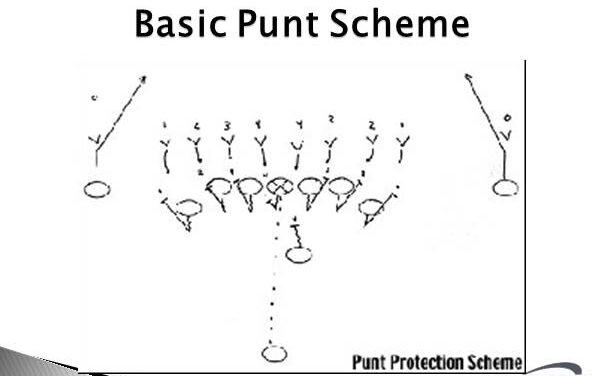
Basically, I wasn’t thrilled with what I saw.  The team was 5-5 in 2001.  We had an average high school punter.  We used the standard 5 linemen, 2 gunners, 2 wings, 1 personal protector and punter formation that you see in the NFL and many other places (Diagram 1).
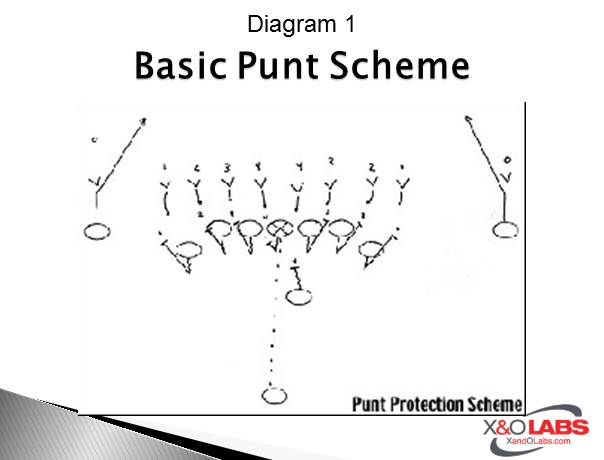
I noticed a few things while reviewing our punt team:

  1. Like what I’ve seen with a lot of high school football players and even college and NFL players, making the tackle in the open field on the punt team is a difficult thing to do. What I saw was that our kids were in position to make a tackle many times, but just didn’t.  They would either get juked by the returner, or have poor fundamentals on breaking down and making the tackle.
  2. The 5 linemen were pretty useless in covering punts.  Why are we sending offensive linemen out on the punt team?  Only one lineman of ours all season made a tackle on the punt team.  Well, the main reason we use them is in protection.  But still, is it a wise use of personnel?
  3. We only had two guys getting off the ball and down the field, the gunners.  The other 8 were focused on protection first, then covering the kick second.  If those two gunners got held up, and weren’t able to fight through their blocks, we have to rely on the linemen and the wings to get downfield AFTER their protection responsibilities.
  4. If the other team only put one guy on each gunner, and one returner deep, this meant they were able to bring 8 for the block.  We would have 8 in for protection, but one of those players is having to first focus on snapping the ball.  And the personal protector, was there to simply pick up anyone the front 7 missed.  Therefore, I felt like we were outmanned.  In fact, we had 3-4 punts blocked because of this during the year.
  5. If we played a team faster than us, we gave up more punt return yards period.  If their returner was faster than our gunners, we lost field position.  There was no way around that.
  6. The geometry and the angles of our coverage unit vs. their return unit made it difficult to keep them from gaining yards and field position.  If a team used a sideline return, they had the advantage of setting that up, knowing where they were going, etc.  We were then on the “defensive” against their return.  I didn’t like that.  Those sideline type returns were very popular ten years ago, and still are today.  They split the field in half, so half of your guys are essentially useless against this type of return as far as making a tackle, etc.  Especially one of your gunners; when they return opposite him, there isn’t much he can do on that play.

So, what do you do to combat these 6 flaws with the standard punt scheme we were using?  How do I “fix” this?


I began a search for a new punt scheme.  I went to all of the usual clinics and read a lot of articles and research online.  I finally found an idea I really loved, and had never seen on the field before- which was about the Shield Punt.  I loved it!  It was totally different than anything I had seen before, which I knew might present some problems for the teams we played.  A phrase I love to apply to Special Teams is “predictability breeds vulnerability.”  This means that if you continue to always do the same thing, you can become vulnerable to attack.  So, something new like this would be great to use!

As with most clinics and articles that I find and want to apply to my own program, I took out of it what I liked, and left what I didn’t like!  So, below is what I came up with and have taught for the last 10 years regarding the shield punt!

Shield Punt Installation

I installed the shield punt!  But the shield punt I use, is different than what you are seeing all over the college landscape the last two years.  It’s become a bit of a fad on the college football scene lately.  I started using the shield punt in 2002.  Check the diagram below:
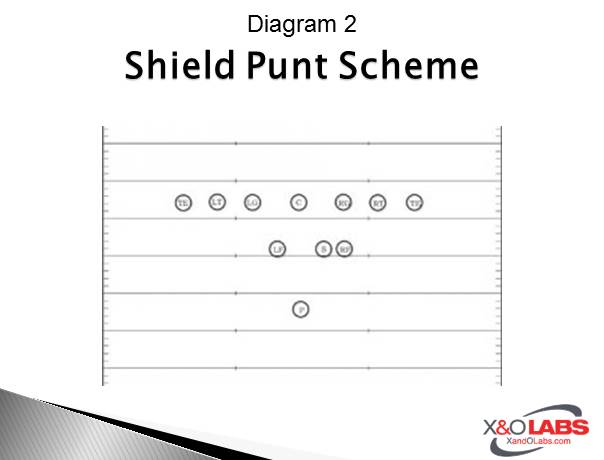
 

Why Use The Shield Punt

We get 7 players in the face of the returner pretty quick.  We aren’t just relying on a few “gunners” to get down and make the tackle.  This is an aggressive punt, where we are on the “offensive” more than the “defensive.”


We are using this punt to maximize our field position, while at the same time minimizing blocks and returns.  By getting our players down the field quickly, the returner will have a tough time making a good, clean catch, and won’t have much room to run if we do this right.  Lastly, the return team will not be able to set up a return because we get down the field so quickly.

Personnel

On the front line of 7, we want to use quick and fast linebacker/safety type football players.  These guys need to be able to get down the field, while also having some size and strength to them for “blocking” their men.  We don’t want slow offensive linemen on this unit in the front seven.  The front seven need to be aggressive kids.  They need to know how to make a tackle in the open field if needed, that is why I like to use defensive players in the front seven.  The three players in the shield are your offensive linemen type guys.  Here, we value size over speed.  They have zero pursuit and tackling responsibility.  Their main job is to create a shield about 7 yards in front of the punter, to block anyone who comes through the front line to block the punt.  Therefore, big and strong offensive linemen types are the best for the shield.

Read More

Unbalanced Shield Punt Scheme

By Jon Kyte

Special Teams Coordinator

University of Dubuque

Editor’s Note:  Coach Kyte entered his first season on the University of Dubuque staff in 2011, directing the defensive line and coordinating the special teams. Prior to coming to Dubuque he spent a season on the Augsburg College (Minn.) staff, directing the linebackers, defensive line and special teams. He also served as video coordinator and assistant recruiting coordinator for the Auggies. Kyte served for two seasons (2008-2009) as an assistant coach (tight ends) at Division II Winona State University (MN), where he coached two all-conference NSIC tight ends.

Jon Kyte of Dubuque University (IA) details his version of the shield punt scheme, where he will overload a formation and meshes a rugby and directional style punt for maximum productivity.  He shares all components of the scheme with XandOLabs.com.

Read More

Cover Two Corner Techniques Based on Receiver Leverage

By James “Mac” McCleary Defensive Coordinator, Notre Dame High School (LA)

Editor’s Note:  Coach McCleary has coached for Notre Dame High School of Acadia Parish, Louisiana for the last 14 years and has been the defensive coordinator for the past 6 years.  During his time as the coordinator, Notre Dame has amassed a record of 73-9.  In his six years as defensive coordinator, Notre Dame has had the opportunity to compete in 3 state championship games. 

In the first article, (click here to view) I discussed how we align ourselves in Cover Two by body position to take away the holes in the field based on the receivers spacing.  In this article we will discuss the reads and techniques we use to accompany these body positions to execute the coverage in a successful way.  With all of our coverage variations, we teach our corners 3 ways to cover; Man Coverage, Cover 2(flat to deep), and Deep (Quarters).

When calling a coverage, the numbers tell the corner what to do.  Example: C-20, Strong Corner play C-2(flats) Weak Corner play C-0(man).

When playing Cover 2 in the middle of field the Corners look at the spacing of the #1 and #2 receivers and line themselves up in one of three body positions.  The corners will press, play choke technique, or play shake technique.

Average Spacing of #1 and #2

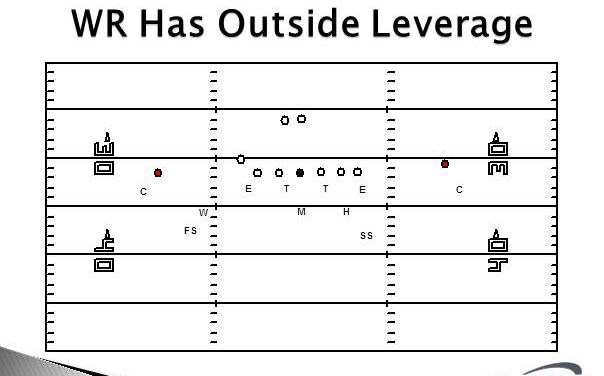
If the #1 receiver’s spacing is splitting the numbers and the hash (average spacing), then the corner will press the receiver with outside leverage.


When pressing the receiver, the corners alignment will be 1 ½ to 2 yards off the receiver with inside shoulder on the receivers outside shoulder.  The corner will have a balanced stance with his feet inside his frame.    Any time our corners press we teach them to focus on the hip of the receiver.  Pre snap we instruct the corner to look at the feet of the receiver to see if the inside foot is back or the outside foot is back.  This gives the corner a pre-snap indicator of the receiver’s first step.  With outside leverage, the corner will always take a back and outside step with his outside foot to protect the outside and deny an outside release.  Remember the reason for pressing the receiver is to funnel him to the safety.  We stress footwork first then hands. We are reading the release of the hips as we are moving back and outside.  Once the receiver’s hips commit to the inside our outside, then we proceed to drive our eyes and outside hand to our target.  Our target is the outside breast plate of the receiver.  We want the corner to jam the receiver with his thumb up.  We tell him to make a y with his hand.  If the receiver outside releases, then we flatten him out and redirect him inside.  If the receiver inside releases, then we drive him in a couple of steps and split the zone back out to the flats.  Once we split the zone or deny the outside release and redirect him inside, then our eyes go to the #2 receiver.  When the corner’s eyes go to #2, he looks for him to come outside.  If he does the corner works him flat to deep (rail) by gaining width and depth.  If #2 goes inside, then the corner sits looking for crossers or the back out the backfield.  If #2 goes vertical, then the corner sinks deeper protecting the corner route.

Read More

Advantages of Turn Protection


By: Justin Iske

Offensive Line Coach

Fort Hays State University

If you are a turn protection (half-man, half-slide) team like we are here at Fort Hays State, the number one job of your o-line coach is to figure out which way you want to slide your protection each week. The purpose of this article is to give you a few ideas that will help you make this determination without confusing your players.


What Is Turn Protection?

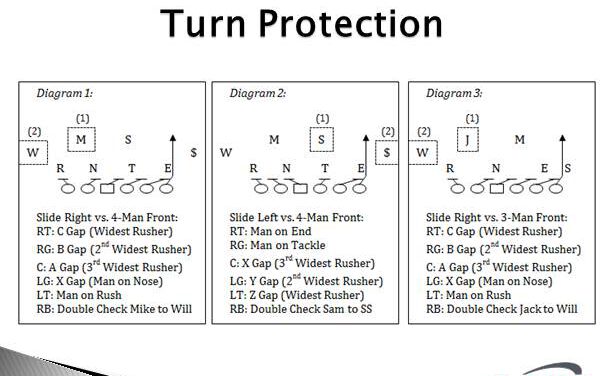
In the simplest terms, turn protection is a half-man, half-slide protection with the center, playside guard, and playside tackle responsible for a gap; and the backside guard and tackle manned up on a defensive lineman. (See Examples in Diagram 1, 2, and 3).

Diagram Notes:

  1.  We call the weakside gaps X, Y, and Z.
  2.  “Rush” is just our term for the weak side End. (End, Tackle, Nose, Rush)

Who Calls the Protection

Sideline – In some systems, the play-caller will determine the slide side of a protection. Some coaches are more comfortable playing the percentages based on film study to determine what a defense is going to do (which are detailed below) and call the protection in the play call. An obvious disadvantage to this is you do not get a chance to see the defense’s pre-snap alignment before determining the slide.


With no-huddle teams, oftentimes the o-line coach or running back coach will signal to the o-line or quarterback the protection call at the line of scrimmage. This gives the coach a chance to see pre-snap alignment, but adds a layer of communication to the process and slows the offense’s tempo down.

QuarterbackThe best reason to give the slide responsibility to the quarterback is that he is the one who is going to pay the price if he sends the slide the wrong way. After he is hit by a free blitzer once or twice, they usually realize the importance of getting the protection correct. Another reason is that the QB has the best pre-snap view of the defense. One reason not to use your QB is that they already have enough on their plate in terms of reading coverages, making route adjustments, and other audibles that you don’t want them to be overwhelmed. This is especially true with an inexperienced QB. Sometimes taking some responsibility off their shoulders can help them be successful.

Center (or Guard) – In our system, our center calls out the defensive front every play. Against some opponents, he will also ID the Mike linebacker. Since he is the one that has to know what front we are facing, it makes sense that he be the one to call out the protection as well. However, there have been times when we have had a guard call the protection instead. For instance, if you have a three-year starter at left guard and a redshirt freshman center, then the left guard is going to handle things better than the center is. We have never had a tackle call out the protection simply because his angle is so much different that he can’t recognize what is happening on the other side of the line.

At the end of the day, any of these approaches can be successful. We have always designated either the quarterback or one of our interior o-linemen as the player to check protections. As the o-line coach, I prefer that it be one of our guys up front, but we will sit down as a staff before every season and evaluate that group of players before we make a decision as to who will have the responsibility of calling the protection. It is important to note that you need to call a slide every play (even on running plays or non-turn protection plays) so that the defense doesn’t have an extremely easy clue as to when you are passing the ball.

Five, Six, or Seven-Man Protection

One of the reasons we use turn protection is because we can incorporate five, six, and seven-man protections with the same rules for the offensive line. We can also run three-step, five-step, seven-step and even some play action concepts while using the same basic principles of protection. The less your guys up front have to think, the more aggressive and confident they will play. The QB and running backs are the ones that adjust.


Definitions of Protection

  • Five-Man Protection: Any blitzer to the man side is the QB’s responsibility
  • Six-Man Protection: RB or FB is responsible for blitzer to the man side.
  • Seven-Man Protection: Both backs will check to the man or slide side, depending on the call.

One thing that is extremely important, for shotgun teams especially. Do not always align your back to the man side of your protection pre-snap. The first thing most defensive coaches will look for when attacking protections is any pre-snap giveaway to which side you are sliding your protection. Realize that they watch film just as much as you do and if you align the back to the man side all the time, you are going to see every blitz ever invented to that side on a weekly basis. Going under center or in the pistol eliminates this issue. But so does simply having the back cross the QB’s face post-snap (with or without a flash fake).

Read More

DB Article – Training the “Nub” Side Corner in the Run Game


By Mark Hendricks

Defensive Coordinator

Lenape High School (NJ)

Bio:  Mark Hendricks is currently the defensive coordinator at Lenape High School in New Jersey.  Prior to his time at Lenape, Hendricks was the cornerbacks coach at James Madison University from 2008-2012.  He was also the defensive coordinator at Rowan University (NJ) for a season. 

Editor’s Note:  The following transcript was written and recorded by Mike Kuchar.   

It’s clear that many offensive coordinators try their hardest to manipulate formations so that they get their tailback in a one on one situations with a Cornerback.  This is typically done by having the strength of the formation away from the Tight End and having the Corner aligned on the same side of the Tight End (Diagram 1). And why wouldn’t they?  Corners have traditionally been known as one of the weaker tacklers on the team.  Well, there are ways to train your “nub side” corner to make plays in both the run and pass game- and Coach Hendricks details all of these methods in this report.


Nub Side Corner in Man Coverage

In most occasions, that backside Corner will be in a man to man situation with that backside Tight End.  Hendricks will have his Corner at a 6×3 alignment (which is six yards deep, and three yards wide) but maintaining out side leverage. “He needs to show up against the run, but may not needed to contain the football.”  According to Hendricks, he will often have a Defensive End or Linebacker to that side as the contain player.  The reason is mainly due to zone read schemes that will arc the tight end.  “The tight end release looks like a pass route,” says Hendricks.  North Carolina busted it against us two years ago because the tight end ran the boot off the inside zone play (Diagram 2).”


Hendricks will use what he calls a man-on-man key in these situations.  “We read high and low hat of Tight End,” said Hendricks.  “If the Tight End blocks, we come on hard vs. run.   If the Tight End releases, we stay over the top and keep leverage on him, but we can’t stay stride for stride with him.”  Many times when the Corner is alone on that Tight End, Hendricks will play a “I and O” (inside and outside coverage) with the remaining linebacker to his side against the Tight End and the back (Diagram 3).  “What we prefer to do is what we call ‘Joe’ where the Corner will play tight end regardless and the linebacker plays the back (Diagram 4).  “The Tight End could crack linebacker and they can swing the back (Diagram 5).  You need to have both because of the crack scheme.  If the Corner is manned up, he will not slide or shuffle.  He has to chase any true crossing route to work though up field shoulder.”

Read More

Defending the Spread with Quarters Coverage


By Matt Puffenberger

Defensive Coordinator

Berkeley Springs (WV)


Editors Note: Matt Puffenberger has been an Assistant Football Coach at Berkeley Springs since 2001 and is currently the Defensive Coordinator/Defensive Back Coach.  Berkeley Springs HS is an AA school located in the Eastern Panhandle of West Virginia.  It had never played in a post-season game prior to 2002.  In 2000, Angelo Luvara came to BSHS after being the head coach at Potomac State College in Keyser, WV for 22 years.  During his tenure, BSHS has won their first playoff game in school history and advanced to the state quarterfinals.

Understanding Our Base Defense

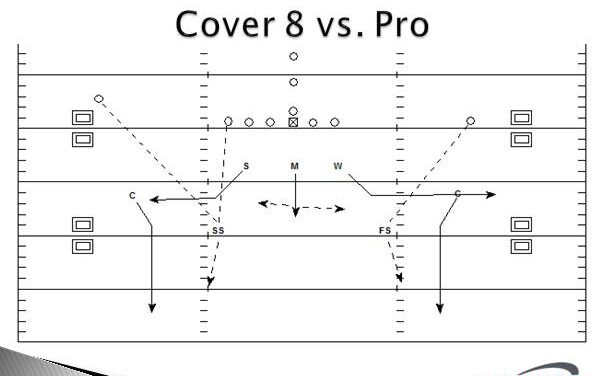
We are a 4-3 base defense that plays primarily Quarter’s or “Split-Safety Robber” coverage (cover 8 in our terminology) the majority of the time.  Our Quarter’s rules vs. Pro Formations:

  • Corner’s = base alignment is 7 yds off and 2 yds inside the WR (we have a divider rule that tells us to take outside leverage vs. short splits) (we will sometimes show press and bail at the snap)
    • vs. run = secondary force/deep cut-off
    • vs. pass = inside deep ¼ (NO POST!)
  • OLB’s = align based on backfield set
    • vs. run = alley vs wide flow, gap alignment vs fast flow; opposite A-Gap away
    • vs. pass = flat-wheel-#3 (OLB’s buzz flats, run with any wheel, then work to #3)
  • ILB = Align based on backfield set
    • vs. run = fast flow to 1st window (a-gap to c-gap strong/b-gap weak)
    • vs. pass = work middle hole for depth, relate to #3, alert crossers
  • Safeties = Align no wider than the hashmark if into boundary, no less than 4 yds inside hash if to the field with heels at 10 yds
    • vs. run = force/cutback
    • vs. pass = man #2 if #2 vertical; rob #1 if #2 not vertical


Adjustments to 1 Back Formations

Our defense basically converts to a 4-2 Nickel-Type defense when facing 1 back formations. Depending on our personnel, we may sub in a 5th defensive back or have a designated LB that will play the “nickel” position.


Nickel Alignment Rules:

  • The Corners take their normal alignments.  If the Corner has a slot, but the Nickel is away from him, he aligns inside shoulder of #1 and inside of 5 yds.
  • The Nickel will align to the passing strength. He will align to the field vs. 2×2 4 WR formations. His base alignment is outside leverage, 5 yds off the line of scrimmage.
  • The OLB will align opposite the running strength and be responsible for the B-Gap vs the run.  If the OLB has a 3 technique to his side, he will make a call that stunts the 3 tech tackle into the A-Gap.
  • The ILB aligns to the running strength and is responsible for the open gap based on front alignment vs. the run.
  • The Safety to the Nickel aligns half-way between #2 and #3, unless #2 is very wide, in which case he aligns closer to #2.
  • The other Safety takes his normal alignment, unless there is a slot receiver to his side, in which case he aligns inside shoulder of #2 at 8 yds deep.

Read More