
Protocols for a Defensive Identification System

By Mike Kuchar

Senior Research Manager

X&O Labs


Introduction

It’s that time of the year when offenses are either being constructed or retooled, so we felt there was no better timing than now to release our latest study on defensive identifiers.  The following information is based on a collection of surveys designed towards offensive coaches in an attempt to decipher the progressions used in three major defensive identifiers- front, second level players and coverage.  While we realize all programs may have different methodologies in uncovering these structures, our goal was to find and provide a common denominator for each.


Case 1:  Identifying Defensive Front

Question 4

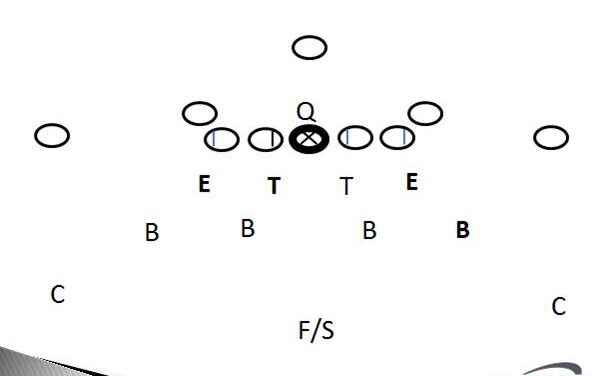
The first part of any identification systems seems to be recognizing the defensive front and more importantly which player makes the call to do so.  Our research was split down the middle when deciding which player makes the front identification call.   According to our research, 53.6 percent of coaches will have their Center make the call to recognize front while 22.6 percent will have their QB handle that responsibility.   Rich O’Connor, the offensive coordinator at Montclair State University (NJ) has his Center’s make all the checks for two main reasons- he’s usually more versed in studying defensive fronts and it’s just another thing that QB’s don’t have to worry about.  “Our QB is asked to do a lot in our system, so we just felt that this is something the Center can handle,” says O’Connor.  On every snap, he’ll have his Center make three calls: identify the front, identify the Mike LB and then give the box count (the amount of players in the tackle box).

We also had a good faction of coaches split the responsibility between the Center and the QB.  “The quarterback and center both have a role in identifying the front. The center is going to make an odd or even call, and identify the Mike,” said James Vint at Cornado High School (TX).  “The QB is going to identify and communicate the “Q” player. The Q player is the defender the quarterback is responsible for in our option schemes.”   Some coaches, particularly at the high school level, will even let their most experienced offensive lineman handle the call.   Others will also have their running back make the call for the skill players.   Regardless of the call, 82.1 percent of coaches surveyed will always identify the defensive front on every snap.

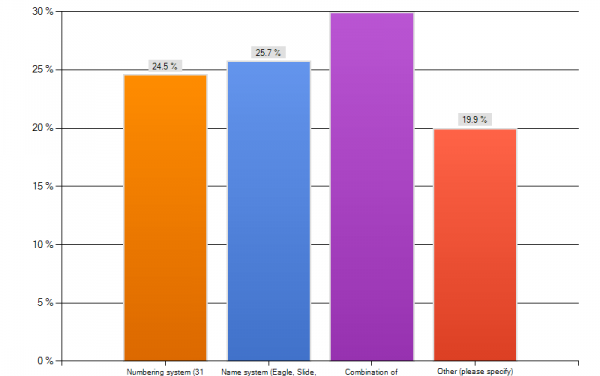
We’ve found that 29.9 percent of coaches use a combination of a numbering system and a name system to identify defensive fronts.   A numbering system mainly refers to the technique of the first level defenders, which would read from left to right.  So in an even front a 13 front would resemble a one-technique or shade to the left and a three-technique to the right.  If the number were 31, than a three-technique would be to the left side while the shade or one technique would be to the right.   Some coaches, particularly spread system coaches even use a color system to indicate where the three-technique is in an even front.  For example, the “red” side may denote the side of the three technique, while the “white” side may be the shade side.    One of the coaches who took our survey verbalized how he identifies an even front.  “When we are facing an even front team the Center will ID the 3 tech with a “red” or “blue” call then he will ID the Mike linebacker twice.  If the defense aligns with a two-technique, the C will make a DEUCE call, then ID the MIKE.  If the defense aligns into an Over front the Tackle that has the ghost 9 tech will make an OSCAR call to the C, the C will repeat and ID the MIKE.  When facing a 34 team the Center makes an OKIE call, then IDs the Mike.  When facing a 33 Stack – the Center makes a “Stack: call, then IDs the Nose guard with a “Zero” technique call.

When we researched this further we did find that 87.5 percent of coaches don’t deviate from a shade and 3-technique side against four down fronts mainly due to the multiplicity that defenses present by pre-snap stems and post-snap movement.   So what is the benchmark number of fronts that offenses should be identifying?   What is too much?  The base number seems to be three or less- 61.9 percent of coaches only use up to three identifications while 34.9 percent use between 4-7 identifications.   Offenses are not trying to limit their verbiage in identifying fronts.  Now, we’ve found that spread teams are simply identifying only the bubble (a gap not accounted for by a first level defender) for zone techniques. They will only use two names and cut the ball in half if either you have an open B gap or a closed B gap.   ” Our Center ID’s front based on where A & B gap defensive linemen are aligned,” said Coach Hagebusch at Nowata High School (OK).  “Next he ID’s the MLB or the LB most likely to blitz to help with pass pro.”

Coach Hopkins at Basehor-Linwood High School (KS) follows the same methodology.  “We only say odd or even. We really don’t consider it “odd” unless there is a true zero-technique Nose guard and we don’t care if there are two or three linebackers,” said Hopkins.   “Due to stemming by linebackers, we don’t focus on names such as Eagle, Bear, etc.”   We did find coaches like Bryan Moore at Heidelberg College who will only identify the front if it is a Bear front-which denotes a zero technique Nose guard and two three-techniques.   Rick Wimmers at Fishers High School (IN) believes in the same simple methodology.  “The Center IDs all fronts as either 3 Down (1 defender in A & B gaps), 4 Down (2 defenders in A & B gaps), or 5 Down (3 defenders in A & B gaps),” says Wimmers.  “The QB IDs the Point with the defender’s number (“51’s the Point!”).”

Some coaches like Thom McDaniels at Glen Oak High School (OH) ties the front into their cadence.  “Our Center will make an Over (4-3), Under (Shade), Odd (3-4), or Even (4-4) call to identify the front,” says McDaniels.  “Our QB identifies the coverage in his cadence.  For example: Red 4, Red 4, Set, Hut declares the coverage as Cover 4; Blue 1, Blue 1, Set, Hut declares the coverage as Cover 1. The color is not significant to the front or coverage. Our OG’s will then make a Tim (inside) or Tom (on or outside) call to identify the location of the first defender to his side.”

Read More

Inside Zone for Maximum Efficiency

By Brent Morrison

Offensive Coordinator

Westerville Central High School (OH)

Editor’s Note:  Brent Morrison is currently the offensive coordinator and QB’s coach at Westerville Central High school in the Columbus, Ohio area.  He has been coaching at WCHS for 8 seasons and coached multiple positions.  He has a total of 12 years high school coaching experience.

When our current Head Coach, John Magistro, took over our program four years ago he was determined that we would be a zone running team.  This was a major transition for the kids and many of the coaches that were used to primarily gap blocking schemes.  So our difficult journey began and we have evolved to a point where the Inside and Outside Zone are nearly 75% of our run game.

This was not an easy place to get to.  We had all read the articles, gone to clinics and talked with other coaches that were knowledgeable about zone offense, and at first we felt like this was exactly the right thing for our program.  Through camp, two-a-days and scrimmages we were looking great, but then we had some downfalls.  Our zone became very inefficient, our QB was making poor decisions and our RB’s were making the wrong reads while carrying the ball.  Basically, everything that we had worked towards was imploding.  We as a staff sat down one Sunday night and had a real heart to heart about whether or not we should scrap the zone.  After about an hour discussion we decided that it was something that we would continue to work on and build our offensive run game philosophy around.

I tell this story not to scare anyone from running the zone, but to give you a reality check that it is not a magical play that will come in and solve all of your offensive issues.  We have devoted a lot of time and effort into creating the package that I am about to share.  We are constantly evolving and growing so that we can become more sound and efficient as an offense.  Some of the things we have actually added this offseason.  In fact we always struggled with how to set our fullback while we were in the pistol.  Thanks to Coach Schmitt from Atholton High School and his article “Pistol Two Back Zone Run Game” for giving us some tags that we felt solved many of our issues.  You may notice some overlap from our articles, but I have found that overlap and redundancy is a common them when reading articles about the Inside Zone.

The last point I want to speak to before we get into the x’s and o’s is about the use of a no-huddle offense.  We are exclusively a no-huddle team and have been for four years, but only in the last two have we been an up-tempo no-huddle team.  I truly believe this has been the key to our IZ being effective.  Inside Zone is all about taking advantages of defensive decision making and a very fast no huddle team focuses on confusing the defense and blurring their decision making.  Combining the IZ with no-huddle is the best way to create maximum efficiency.  Our tagging system has evolved and is continuing to, but hopefully our work can be of some value to you.  Also, I am not using our real tags, since we try to protect our no-huddle language as much as possible, but I am sure your staff can come up with your own creative terms/signals for these schemes if you chose to employ them.

Inside Zone read vs. Veer Read

We run inside zone with our line in both our inside zone and our Veer series.  Our Offensive Line has no idea what the difference is, because for them there isn’t.  If we run IZ or Veer the difference is where the back will attack first.  If we call Inside zone right read as pictured above, then the RB is attacking the zone side B gap.  If it filled then he works his way back across the zone to play side A, and finally backside to the backside A gap.  If we are running veer left read then it looks exactly like IZ right read, except QB and the RB change.  The QB’s technique we teach is funnel the RB to the right hole.  We went away from exact steps because when working from the gun, the snap often time will create different starting points for the QB.  The RB is then told to run the toes of the QB.  In the IZ series the RB starts on the opposite side and gets funneled to the B gap away from him.  If we are using the veer series, then the QB will funnel the RB to the A gap on the same side.   The QB’s read is not much faster and the RB will read veer side A to backside A.  The Veer series is primarily used from our Pistol backfield, but can also be used in a traditional gun set.  All of the veer plays will be drawn from the Pistol set throughout this presentation.

Read More

Defending the Flexbone


By Jason Brown

Secondary Coach

Dutchtown High School (LA)

Editor’s Note:  Jason Brown is the Secondary Coach at Dutchtown High School in Geismar, Louisiana. He has been coaching for 23 years with 18 of them serving as a Defensive Coordinator at various high classification schools in Louisiana. Dutchtown High School has a 31-5 record over the last three years and their defense has contributed greatly to this success. Some notable former players for Dutchtown High School include Eddie Lacy (RB Alabama), Eric Reid (DB LSU), and Landon Collins (DB Alabama).

It is an honor to represent the defensive staff at Dutchtown High School in presenting this article on Defending the Flexbone Offense. It is my goal to stimulate thought and to take you through the concepts that we have developed to try to combat this offense and its variations. The material encompasses all of the trial and error that all of our defensive coaches have gone through and continue to go through in defending this particular type of offensive scheme.  Due to limited space I will not be able to go into great detail on each technique or scheme, but hopefully you will find some ideas on how to defend this type of offense. I will also concentrate mostly on the triple option and play action aspects of the offense. Though we know we don’t have all of the answers, I do feel like we have something worthwhile to share on a concept of which little information is available.

In developing our defensive strategy for the Flexbone offense, we have gone through a multitude of defenses before we settled on the concepts that we have today. In the beginning we started with a basic 4-2 scheme with 3 Robber coverage (Diag. 1). We put the tackles in double one techniques to expand the crease, and put the ends in tight five techniques.  Within this scheme we also played crack and load concepts on the perimeter. The outside rotators and the free safety read the slot back and fit accordingly. If the slot load blocked, the outside rotator squeezed for the quarterback and the free safety fit opposite to the pitch (Diag. 2).


If the slot arc blocked, the outside rotator expanded to the pitch and the free safety fit opposite to the quarterback (Diag.3). In the beginning this seemed like it would be enough.  We enjoyed great success against the offense, but the offenses started figuring out ways to counter what we were doing. With the advent of different blocking schemes on the perimeter to get to our single safety, we found out quickly that we could not stay in this scheme any longer. The single high safety was crack bait and if you didn’t have a war daddy in that spot the scheme just wasn’t as effective.  This offensive attack confirmed some basic principles of defense that we had been exposed to for generations. Power offenses demanded 8 and 9 man fronts and option offenses demanded 7 man fronts.  At he time we really like our four man front approach and modified it in order to defend from a 4-3 look with true quarter’s coverage (Cover8) (Diag. 4).

This scheme, with its adherence to our philosophy of playing a 7 man front to option football, allowed us a better comfort level in defending this offense.  The Mike linebacker was the inside-point player (Dive-QB-Pitch) and the outside backers and safeties were on crack and load reads (Diag. 5). We had one change up that we really liked and it was called exchange. In an exchange call the End would take the QB, the outside backer would take the Dive (we told them to own the B gap) and the Mike linebacker deepened to 8 yards and tracked the ball sideways, to get an extra alley player (Diag. 6).  Since offensive coaches figured out better ways to block the perimeter versus our Quarter scheme we saw that we needed to add more coverage variation to keep the offense guessing. We decided to stay with our split safety concept and add Cover 2 to our repertoire in option defense. Of course we already played the coverage so it wasn’t a big jump for us, but it did force us to spend more practice time because we were adding a concept to our defense. With only the Mike linebacker inside we found that the counter actions were tough on him, and sometimes the dive could cut back hard behind him because he didn’t have a buddy inside.  We decided to start changing the front structure to more 3-4 looks. We didn’t think we had enough pressures within our scheme to create plays for ourselves against the Flexbone teams. Our goal was to out execute them, but as we all know sometimes you have to pressure to create negative plays. The 3-4 looks allowed us to pressure a bit more, give the Mike linebacker a buddy, and stay sound versus the option. We figured with all of these answers we would have a comprehensive scheme that would take care of any situation we would encounter. As you are reading this article you could possible come to the conclusion that a combination 3-4/4-3 defense with multiple split safety coverage, and certain perimeter reads to help protect yourself versus blocking schemes is perfect. In theory it might be so, but we found that the scheme became a monster. As the scheme grew we started having more mental errors and we found that our players were playing tentative. We had to really do some soul searching to figure out the things that we liked and toss out the rest.

Read More

Creating Disruptive Underneath Coverages

By Steve Nelson

Head Coach

Fowler High School (CA)

talking to thomasEditor’s Note:  Steve Nelson is the Head Football Coach and Strength and Conditioning Coach at Fowler High School in Fowler, California. His 3-year record is 31-6, including 2 section championships and 3 league championships.  He was selected league coach of the year 3 times in addition to being selected to coach local all-star games twice. During that span, Fowler defenses have held opponents to an average of 13 points per game. Prior to becoming the head coach at Fowler, he served at defensive coordinator at Mt. Whitney High School in Visalia, Calif. and at Selma High School in Selma, Calif. Nelson graduated from Fresno State University. 

In our 3-4 defense we base in a 4 man pressure, quarters coverage scheme.  Our underneath defenders play a big role in how effective we are and how loose or aggressive we need to be with our secondary.  Unfortunately, we don’t have the kind of athletes that are division 1 college-type players that allow us to man cover or do more 1-on-1 type schemes.  Instead we have taken the match-up zone concept from basketball and applied it to our defense.  Our linebackers are asked to follow a specific progression that allows us to soundly match-up to any route combination.

To identify receiving threats we use the simple numbering system shown in diagram 1.  The eligible receiver closest to the sideline is the #1, the next is #2, etc.  This counting system applies to both sides of the ball, meaning there could be a number 1 or 2 on both sides of the ball.  This counting system allows us to easily assign a coverage progression to each underneath defender.  The outer-most defender follows a #2-#1 coverage progression, and the middle defender follows a #3-#2 progression.  The idea is to initially cover the first receiver in the progression and then move to the other if the first receiver goes to another area.

We use the CMA responsibility concept to guide our underneath cover guys.  CMA stands for Collision, Match, Alert.  Our primary responsibility is to collision (Diagram 2) the first receiver in our progression if he presses vertically past 5 yards (our lb depth vs. detached #2).  If the receiver stems to our inside shoulder, we collision violently, but do not follow.  If the receiver stems to our outside shoulder, we collision and try to re-direct his route toward the numbers.  We stay with this receiver until he reaches a depth of 10-12 yards before moving to the 2nd receiver in the progression. If #2 is a TE we will align on the LOS, outside eye of TE and collision any release before progression to the #1 receiver.  We view getting to #1 vs. an attached #2 secondary to physicality at the LOS on a TE.  We make adjustments in our secondary play to allow our OLB to be more aggressive in the box.

If the receiver does not push vertically for 5 yards—meaning he runs a shallow crossing route or flat route—we are not going to chase, attack or cover him.  We are going to match (Diagram 3) any out breaking short route by working to the inside hip of the next receiver in the progression.  This gives us the outside leverage necessary not to get out flanked, but also takes away deeper passing lanes. (Note: if there is no #2 receiver, the LB will work immediately to the inside hip of the #1 receiver. Diagram 4.)

Read More